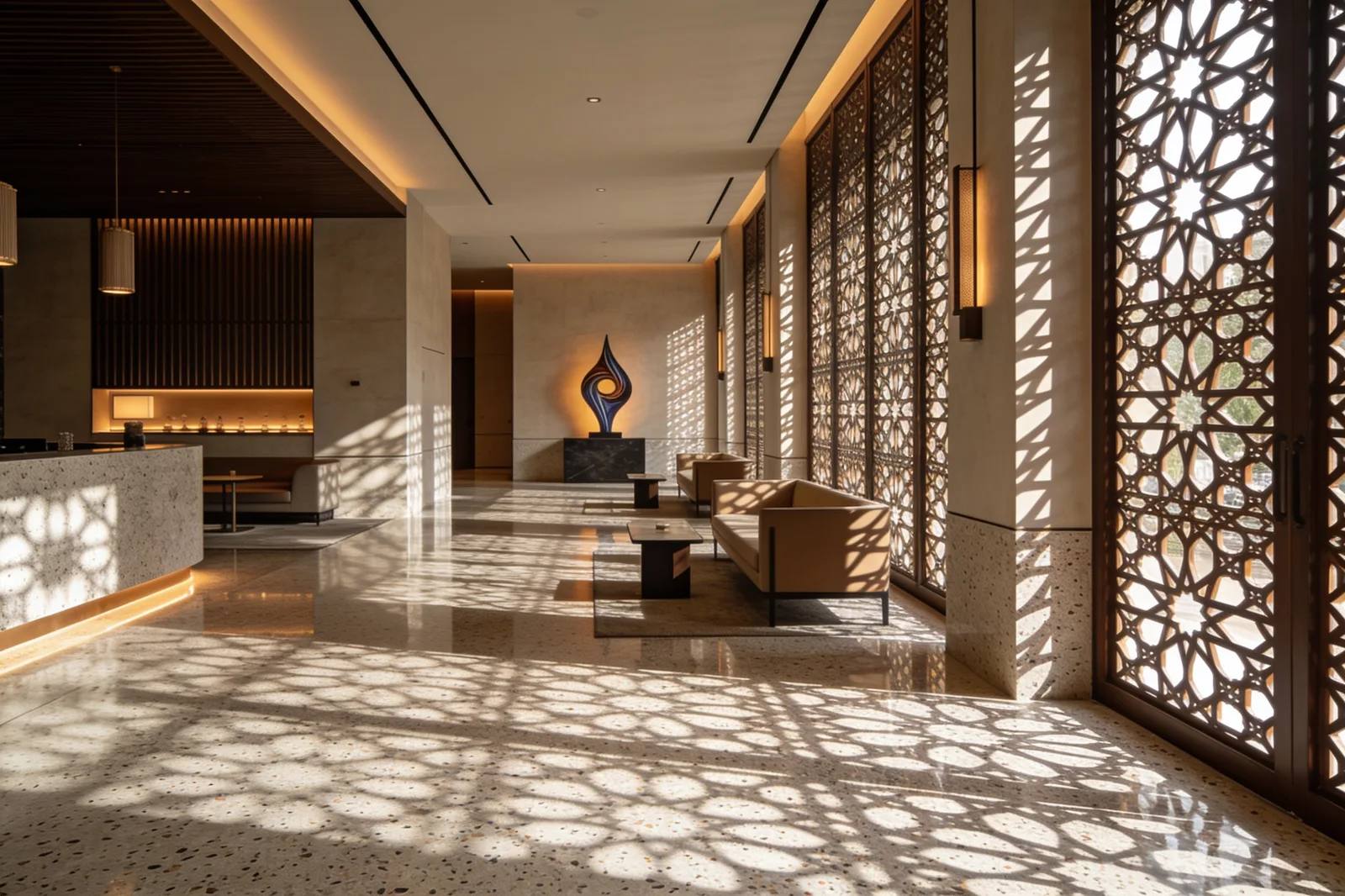
Design-led boutique dubai hotels compete on architectural originality and spatial personalization. Properties integrating local materials, adaptive heritage structures, and guest-controlled environments offer distinct value to travelers who book direct. This shift reflects luxury hospitality moving toward experience-driven stays where the physical space itself is the primary amenity.
How Dubai's boutique hotel scene shifted toward architectural identity
Dubai's hospitality market has matured beyond the mega-resort template. While the city built its reputation on record-breaking scale, a parallel sector of smaller, architecturally significant properties has gained traction among travelers who prioritize immersion over spectacle. These boutique Dubai hotels invest disproportionately in material quality, spatial narrative, and connection to place.
The Design Hotels network requires each independent property to be a wholly unique creative expression, steeped in the history, culture, and nature of its location. FORM Hotel Dubai, a 136-room property and the sole Design Hotels member in the Middle East, exemplifies this standard. Its membership signals a verified commitment to design integrity rather than merely stylish interiors.
Recent development activity highlights this material focus. Hospitality Design's 2025 Dubai development update highlights projects including Delano Dubai and The Lana, specifying finishes such as grained wood, marble, carved stone, terracotta, polished plaster, and textured tile. These are foundational elements that shape how guests inhabit and remember a space, not decorative afterthoughts.
What distinguishes design-led boutique hotels in Dubai
- Architecturally significant structures or conversions with small room counts
- Material palettes referencing local craft traditions or regional geology
- Guest-facing customization of spatial conditions, not just service add-ons
- Direct booking channels that communicate narrative and enable pre-arrival personalization
Architectural features that drive direct discovery and booking
Distinctive architecture functions as organic marketing. When a property's facade, circulation sequence, or room typology is genuinely unusual, guests photograph and share it, generating discovery outside algorithmic distribution channels. This visual specificity creates brand recognition that rewards direct search behavior.
- Mashrabiya screens and perforated metalwork filter light and maintain privacy while creating dramatic shadow patterns throughout the day. These are integrated building systems, not applied motifs.
- Courtyard and wind-tower adaptations reactivate passive cooling strategies from Gulf vernacular architecture, offering thermal and spatial experiences unavailable in conventional tower hotels.
- Open-plan bathroom and sleeping configurations use freestanding tubs positioned as sculptural elements, retractable partitions, and varied ceiling heights to create residential scale within hotel rooms.
- Material continuity from exterior to interior produces coherence when the same stone, plaster, or wood species extends from facade to lobby to guestroom, something branded luxury hotels rarely achieve.
The Design Hotels validation process explicitly evaluates this architectural integration. Properties cannot buy membership through renovation budgets alone; the design must respond to its specific context. For travelers, this creates a filter: membership or comparable independent curation indicates that aesthetic claims have been externally assessed.
When guests encounter these features through social documentation or editorial coverage, they tend to seek the property directly rather than browsing generic inventory on third-party platforms. The specific room, the particular light condition, the exact suite configuration matters. This specificity undermines the comparison-shopping model that online travel agencies optimize for.
Why distinctive architecture resists platform commoditization
Online travel agencies standardize presentation: square footage, bed configuration, amenity checklist. Direct websites and booking engines allow narrative sequencing, video documentation, and room-specific imagery that preserves architectural intent.
Personalization through spatial design and guest control
Personalization in design-led boutiques extends beyond pillow menus and welcome notes. The physical environment itself becomes adjustable, allowing guests to calibrate their experience without service intervention.
FORM Hotel Dubai has advanced this approach since its 2018 opening. Dezeen's coverage describes how guests can customize their experience through add-ons purchased during the booking process, including toiletries selection, private butler service, and activities. Founder Tarek Daouk states that allowing customers to curate their experience enhances their stay. This operates at the intersection of spatial and service design: the hotel's systems architecture enables granular choice without operational friction.
| Feature category | Guest control | Design intent |
|---|---|---|
| Lighting | Scene-based presets, circadian programming, individual fixture dimming | Adapts room atmosphere to jet lag, work schedules, or mood |
| Climate | Zonal temperature, humidity, and airflow adjustment | Compensates for extreme exterior conditions with interior precision |
| Acoustics | White noise, directional sound masking, entertainment integration | Protects sleep quality in dense urban locations |
| Furniture configuration | Modular seating, movable partitions, transformable work surfaces | Extends room utility across stay purposes without changing rooms |
| Amenity placement | Pre-arrival selection of brand, scent, or functional category | Reduces visual clutter of unused items; signals individual recognition |
The technology disappears; the responsiveness remains. This matters for design-conscious guests who reject the gadget-forward aesthetic of early smart hotels.
The available research does not establish that such customization options are common across all Dubai boutique hotels or exclusive to direct bookers. FORM Hotel's model, documented since 2018, represents a specific operational philosophy rather than sector-wide practice. Travelers should verify personalization scope with individual properties before booking.
The direct booking advantage for design-focused stays
Booking directly with a boutique property yields concrete advantages that compound when the hotel's primary value is experiential rather than transactional. These benefits are structural, not promotional: they follow from how design-led hotels organize information and inventory.
Grand View Research reports that direct bookings accounted for 42.7% of global luxury hotel market revenue in 2025. This figure encompasses all luxury properties, not design-led boutiques specifically, and is not Dubai-specific. It does indicate, however, that a substantial segment of luxury travelers already bypass intermediaries, suggesting established behavior patterns that boutique properties can leverage.
Direct booking advantages
- Access to room-specific inventory not distributed to platforms
- Pre-arrival communication about design features and customization options
- Flexible modification policies for experiential bookings
- Direct relationship with staff who can interpret and fulfill specific requests
Platform booking limitations
- Standardized room categories that obscure architectural variation
- Delayed or filtered communication to property staff
For design-led properties, the direct channel enables narrative commerce. A guest booking through the hotel's own system encounters the architect's statement, the material sourcing story, the art program documentation. This context increases perceived value and reduces price sensitivity. The same room presented through an online travel agency appears as a commodity; presented through the property's own channel, it becomes a specific experience with attributable creators.
Pre-arrival personalization also depends on direct communication. When a guest indicates preference for a particular light temperature or requests that a movable partition be positioned for workspace rather than lounging, that information must reach operations staff intact. Platform messaging layers introduce delay and potential loss. Properties with established direct booking strategies invest in systems that preserve guest intent through to execution.
Travelers seeking to see hotels in Dubai with verified design credentials can use curated search tools that filter for architectural significance and independent ownership. These platforms maintain direct booking connections that preserve the property's narrative integrity.
Perceived value, retention, and the experience economy
Design investment in boutique hotels operates as a retention mechanism. Guests who select properties for specific spatial qualities develop preference patterns that resist platform-driven switching. The hotel becomes a known quantity, a calibrated environment, rather than an interchangeable night's sleep.
This dynamic is particularly pronounced in Dubai's competitive market. With extensive luxury inventory across all price points, properties that compete on rate alone face continuous downward pressure. Properties that establish distinctive spatial identities create inelastic demand from a self-selecting guest segment.
The experience economy framework, applied to hospitality, suggests that guests increasingly purchase transformation rather than accommodation. A design-led boutique hotel offers the possibility of altered perception: different light quality, different spatial rhythm, different relationship to material. This is luxury as specificity.
XVA Art Hotel's positioning in Al Fahidi illustrates this. Its conversion of a traditional courtyard house creates conditions that no new-build tower can replicate: the scale of the original rooms, the quality of filtered daylight, the acoustic separation from street noise. Guests who value these conditions return; they also book direct on subsequent visits, having established trust in the specific experience.
The research does not provide verified data comparing retention rates between design-led boutiques and standard luxury hotels in Dubai. What the documented properties suggest is a qualitative pattern: architectural specificity creates emotional attachment that platform-based comparison shopping undermines. Properties that communicate their design narrative effectively through direct channels capture guests who are seeking that attachment.
Identifying authentic design-led properties
Not every hotel claiming boutique status delivers architectural integrity. Discerning travelers need evaluation criteria that separate genuine design investment from surface styling.
- Architectural authorshipNamed architects or designers with verifiable portfolios, not anonymous "design teams." The property should be attributable and documented in architectural press.
- Material specificityIdentified stone species, wood origins, craft techniques. Generic "marble" or "hardwood" suggests sourcing opacity; "Travertine from Ras Al Khaimah" or "date palm fiber composite" indicates procurement depth.
- Spatial variationNo two rooms identical. True boutique properties accept the operational complexity of unique layouts rather than repeating standardized modules.
- Contextual responseDesign decisions that reference climate, history, or cultural practice of the specific location, not imported aesthetic templates.
- Operational integrationStaff who can explain design intent and facilitate guest use of adjustable features. Design that requires staff interpretation to function fully.
Travelers can see hotels in Dubai that meet these criteria through specialized curation services that evaluate properties against design integrity standards rather than star ratings alone. Hotel Curation lists boutique hotels in Dubai by neighborhood.
Superficially branded hotels, by contrast, apply consistent visual packages across multiple locations. The same lobby furniture, the same bathroom fittings, the same artwork program appears in Dubai as in Mexico City or Bangkok. This standardization enables operational efficiency but precludes the location-specific immersion that defines genuine boutique hospitality.
The XVA Art Hotel distinguishes itself in Dubai through personal touches despite the high volume of hotel rooms in the city.
Curating your design-led stay in Dubai
Practical selection of boutique Dubai hotels requires matching personal priorities to property specialization. The city's design-led sector is not uniform; different properties optimize for different experiential outcomes.
For travelers prioritizing cultural immersion, heritage conversions in Al Fahidi and adjacent districts offer direct contact with Gulf architectural history. Hotel Curation features a collection of Dubai hotels with local character.
For those seeking contemporary architectural statement, newer properties in Downtown and Business Bay areas feature internationally recognized designers and experimental material applications. Guides to iconic architecture in the boutique segment document these projects and their specific design claims.
Travelers interested in how boutique hotels curate atmosphere for luxury experiences should examine properties' programming: art collections, scent design, sound environments, and gastronomic partnerships. These elements extend spatial design into temporal experience, shaping how guests inhabit the property across a multi-day stay.
When evaluating options, travelers should verify that claimed design features are operational rather than merely present. A smart lighting system that staff cannot explain or adjust is decorative technology; a material palette that requires special maintenance protocols and receives it indicates genuine organizational commitment.
To see hotels in Dubai with verified design credentials and direct booking availability, use search tools that filter for independent ownership, architectural recognition, and guest customization options. The most reliable properties will communicate their design narrative clearly, offer specific room descriptions rather than generic categories, and enable pre-arrival contact with staff who can facilitate personalization.
What to verify before booking your design-led stay
Final selection of a boutique Dubai hotel rewards specific inquiry. Request current photography of the exact room category under consideration, not representative images. Confirm which design features are standard versus which require advance arrangement. Ask about maintenance schedules for specialized systems like automated shading or integrated audio.
For heritage properties, inquire about accessibility constraints that traditional architecture may impose. For contemporary properties, verify that smart systems have manual overrides and that technology infrastructure does not compromise material quality.
Direct booking channels should facilitate this inquiry without friction. Properties that resist detailed pre-booking communication may lack the operational integration that design promises. Those that engage substantively demonstrate the guest relationship model that distinguishes boutique hospitality from platform-mediated transactions.