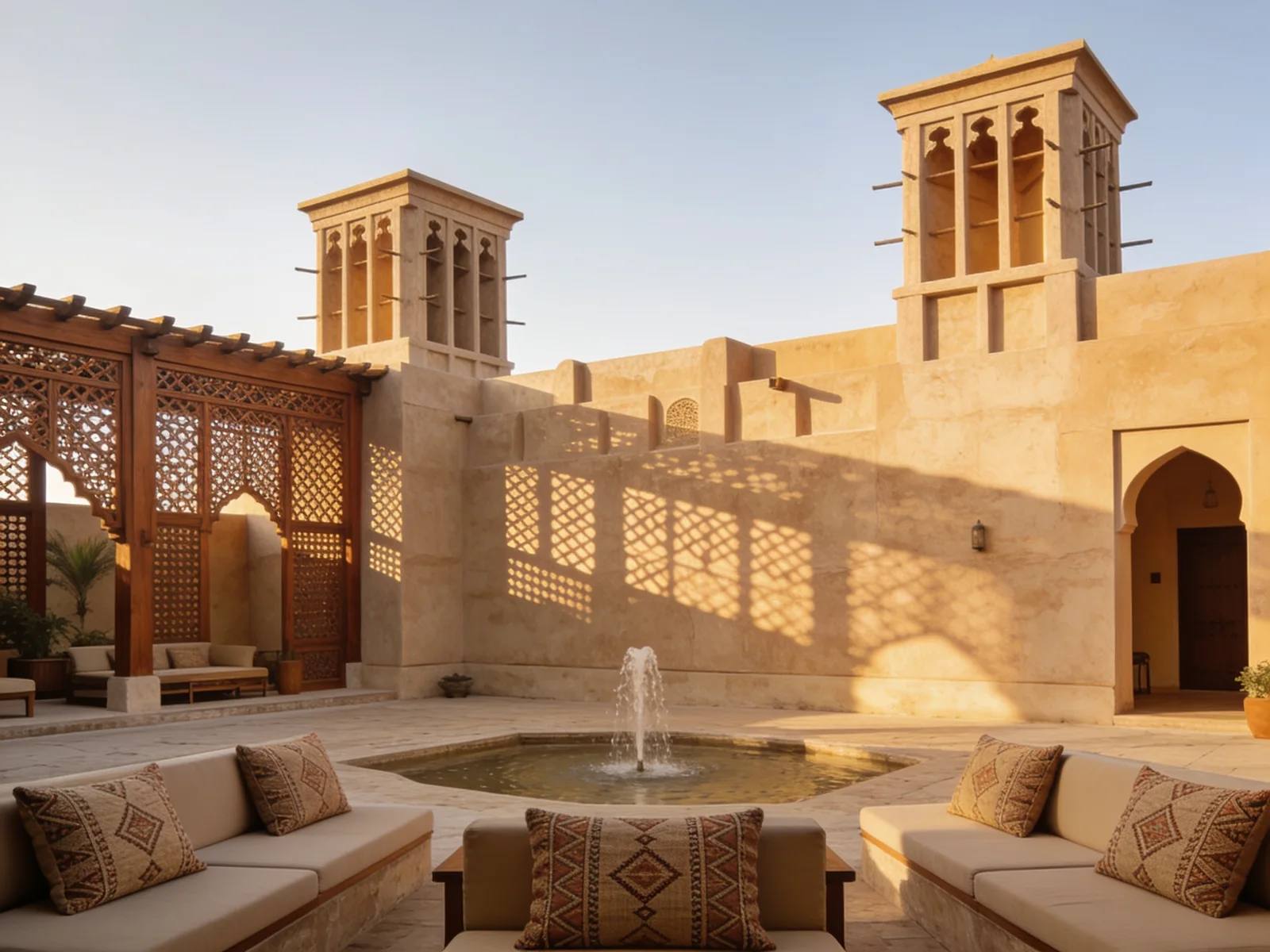
Dubai's boutique hotels distinguish themselves by embedding Emirati heritage into every layer of the guest experience. Rather than replicating international luxury formulas, these properties draw on Bedouin traditions, regional craftsmanship, and historic architectural forms to create stays that feel rooted in a specific place. For travelers seeking more than standardized comfort, and for hoteliers aiming to differentiate in a crowded market, this cultural integration has become the defining feature of the sector. See hotels in Dubai that embody this approach.
Architectural homage: traditional elements in modern spaces
Contemporary boutique hotels in Dubai re-engineer vernacular building techniques to solve modern environmental and spatial challenges. The barjeel, or wind tower, once circulated cooling breezes through courtyard houses in the pre-electric era. Properties such as Arabian Boutique Hotel and Barjeel Heritage Guest House now incorporate functional or restored wind towers directly above suites, turning this passive cooling device into a signature architectural statement.
Central courtyards (hosh) serve a similar dual purpose. At XVA Art Hotel and Al Seef Heritage Hotel, shaded, inward-facing courtyards moderate desert heat while preserving privacy (sitr), a principle deeply valued in Emirati domestic architecture. Guests move through these calm, enclosed spaces before reaching their rooms, experiencing a spatial rhythm alien to conventional hotel corridors.
Mashrabiya screens provide another inherited solution. Laser-cut metal and carved wood versions filter intense daylight into geometric patterns without the thermal penalty of full glazing. The result is interior light that changes through the day, marking time the way desert dwellers once read shadows on courtyard walls. According to Arab America, these elements collectively demonstrate how traditional UAE building knowledge addresses contemporary sustainability concerns.
Materials reinforce the connection. Rammed earth, coral stone, and date-palm timber appear in finishes and furniture, their textures and thermal properties selected for desert conditions rather than imported aesthetic trends. This material honesty matters to guests who can sense when a "Middle Eastern theme" is surface dressing rather than structural logic.
Local art and craftsmanship integration
Boutique hotels in Dubai have moved beyond purchasing decorative objects to building sustained relationships with regional artisan networks. The most documented example is Hotel Indigo Dubai Downtown, which opened in October 2020 as the first certified boutique hotel in the UAE. According to The National, the property collaborated with local organizations including the Fatima Bint Mohamed Bin Zayed Initiative (FBMI) and the Alserkal Cultural Foundation to integrate Sadu weaving patterns into wall treatments and soft furnishings.
Tashkeel's commercial arm, Tasmeem Tashkeel, produces hospitality furniture using PlyPalm (date-palm timber) and Al Sadu upholstery, supplying pieces that carry provenance into guest rooms. Irthi Contemporary Crafts Council and Al Ghadeer UAE Crafts create custom woven screens, wall dividers, and lighting elements for boutique venues, translating skills preserved in domestic contexts into public, commercial scales.
These collaborations do more than decorate. They create economic continuity for crafts threatened by mass production, and they give guests tangible contact with living traditions. A room divider woven by a specific collective in Sharjah carries information that a factory-made equivalent cannot. For properties pursuing design strategies that integrate local identity, this sourcing depth becomes a competitive asset.
Pearl diving motifs appear in metalwork and textile patterns, referencing the industry that structured coastal Emirati life before oil. Calligraphy, both classical and contemporary, moves beyond lobby quotations to become environmental graphics, wayfinding, and room identification. The cumulative effect is an interior that narrates occupation and history rather than asserting abstract luxury.
Cultural storytelling in boutique hotels
The most effective boutique hotels extend cultural integration from physical space to programmed activity. This is where properties differentiate most sharply from international chains that may import comparable thread counts but cannot replicate situated knowledge.
Traditional majlis gatherings offer structured social encounter. Guests sit on low cushions, receive Arabic coffee (gahwa) poured from a dallah in the specific sequence of hospitality, and engage with hosts trained to explain the ritual's significance. The format inverts typical hotel dynamics: the guest is received as a visitor to a home rather than a customer at a service point.
Falconry introductions, sometimes held on desert-adjacent properties or in partnership with heritage centers, connect guests to a practice with millennia of regional history. The activity carries environmental education (falconry's role in sustainable hunting) and legal context (the UAE's protection of traditional practices) that enrich it beyond novelty.
Heritage walks led by Emirati guides through districts like Al Fahidi and Bur Dubai layer personal family memory onto architectural observation. XVA Art Hotel, occupying the former Seddiqi family home in Al Fahidi, offers direct contact with this narrative: guests sleep in rooms themed around heritage items such as the Dishdash, Gutra, and Henna, surrounded by works from the region's contemporary art scene.
Arabian Boutique Hotel operates across two preserved historic residences in Bur Dubai, offering guests inhabiting spaces that witness the formation of the modern UAE. As documented by Historic Stays 101, the property's structure itself becomes the primary narrative device.
The value of authenticity for travelers
Guest preferences in Dubai have shifted measurably. KPMG Middle East reported in April 2025 that Sidharth Mehta, Partner and Head of Real Estate and Construction at KPMG Lower Gulf, noted visitor satisfaction reached 94%, driven by diversification into cultural heritage, culinary tourism, and wellness experiences. The KPMG research specifically notes that younger traveler segments prioritize cultural immersion and destination identity over corporate luxury formulas.
This preference has commercial consequences. Properties that deliver authentic local character command rate premiums and generate repeat bookings through emotional connection rather than loyalty program mechanics. The satisfaction data suggests that guests who feel they have understood a place return more readily than those who have merely consumed amenities.
The contrast with international chain uniformity is stark. A standardized luxury room in Dubai could exist in Doha, Singapore, or Mexico City with only the view changed. Boutique properties that integrate wind towers, Sadu textiles, and majlis hospitality create irreplaceable experiences tied to specific geography. For loyalty strategies in Dubai's hotel market, this uniqueness often outperforms points-based retention.
The 18.72 million international overnight visitors Dubai received in 2024, as reported by the Dubai Department of Economy and Tourism, included a growing segment explicitly seeking this depth. The trajectory continued through 2025, with 19.59 million visitors reinforcing that cultural anchoring attracts market share.
Marketing cultural identity in a global market
Promoting local character without reducing it to stereotype requires narrative discipline. Successful boutique hotels in Dubai avoid the "Arabian Nights" visual shorthand of camels, pyramids, and generic exoticism. Instead, they build content around specific makers, specific buildings, and specific practices with documented histories.
Photography emphasizes craft process over polished product: a weaver's hands at a Sadu loom, the tooling of a mashrabiya screen, the layering of a traditional meal. Video content follows guests through actual experiences rather than staging aspirational montages. The message is that authenticity is accessible, not that the guest will become someone else.
Partnerships with cultural institutions lend credibility. Properties that host exhibitions in collaboration with Tashkeel or display works from Irthi Contemporary Crafts Council can reference these relationships directly, grounding marketing claims in verifiable collaboration. Storytelling approaches for Dubai hotels increasingly adopt this documentary tone.
Staff training completes the loop. Employees who can explain why a wind tower works, who wove a particular textile, or how gahwa service varies by region become narrative ambassadors. Marketing promises made online must be fulfilled by informed human contact at arrival.
For hotel owners considering this path, the operational commitment is substantial. Sourcing from artisan networks requires longer lead times than purchasing from hospitality catalogs. Heritage buildings demand specialized maintenance. Staff need cultural education alongside service training. The return, however, is a property that cannot be replicated by competitors with larger capital reserves but shallower local roots.
What to look for when booking
- Verify whether architectural features like wind towers or courtyards are functional elements or decorative afterthoughts
- Ask about specific artisan partnerships rather than accepting generic "local craft" claims
- Check whether cultural activities are hosted by trained practitioners or outsourced entertainment
- Consider properties in historic districts like Al Fahidi and Bur Dubai for maximum heritage immersion
Travelers ready to move beyond formulaic luxury will find Dubai's boutique hotel sector increasingly sophisticated in its cultural integration. See hotels in Dubai that prioritize this authentic connection to Emirati heritage. Properties seeking to develop or refine their own cultural positioning can see the services available to support this differentiation.