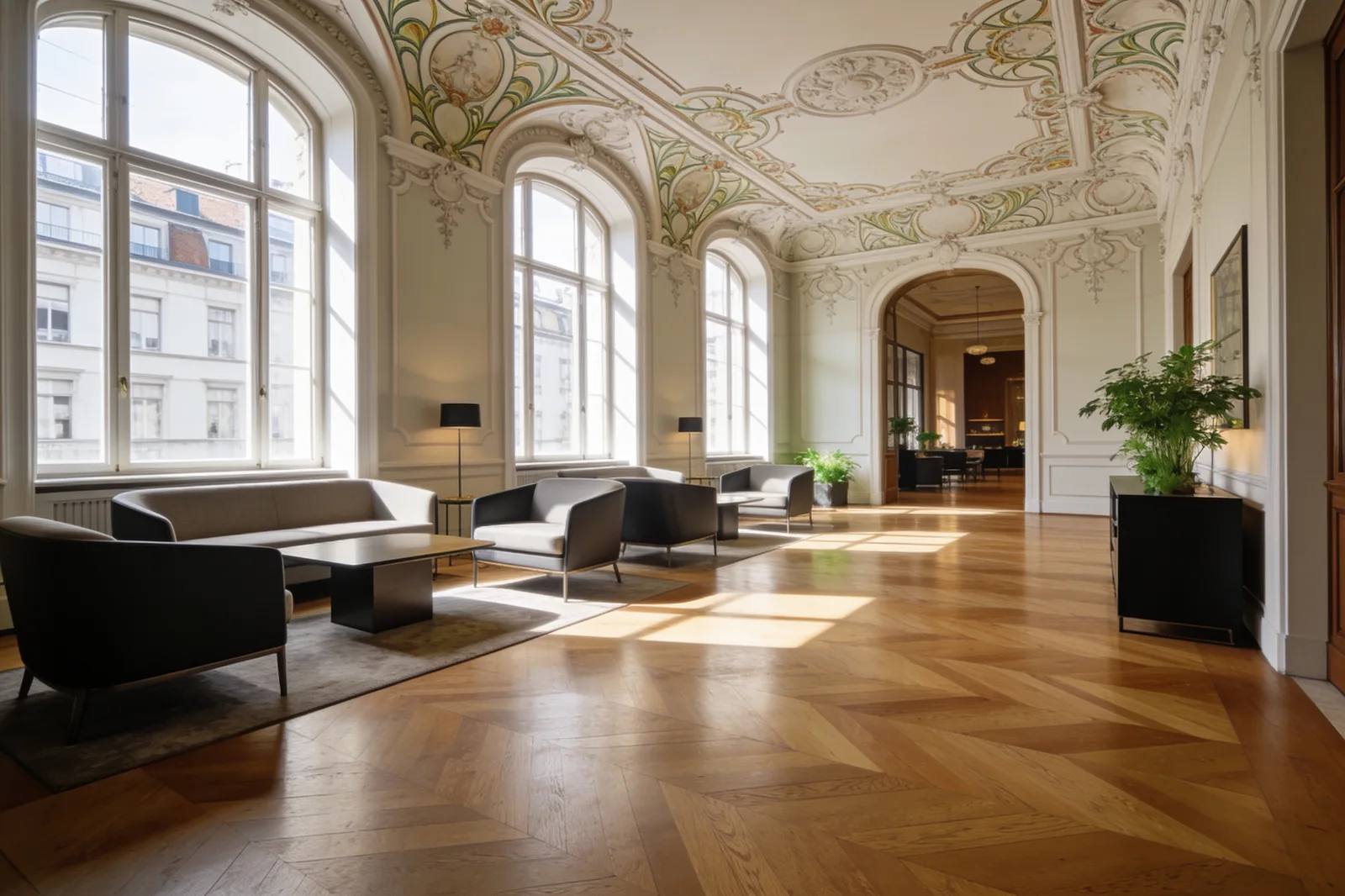
Zürich's boutique hotels let you sleep inside architectural history, from medieval guild houses to converted breweries and Belle Époque lakefront palaces. Booking the right room means understanding which buildings preserve original frescoes and industrial structures, and when to reserve for the best rates and views. See hotels in Zürich to check current availability across these landmark properties.
The architectural styles shaping Zürich's boutique hotels
Zürich's hotel architecture falls into three distinct lineages that travelers encounter in different neighborhoods. Knowing which style appeals to you narrows your search immediately.
Jugendstil and the Swiss Art Nouveau tradition
Jugendstil, the Germanic branch of Art Nouveau, infuses Zürich's turn-of-the-20th-century hotels with organic botanical reliefs, asymmetrical gables, curved wrought-iron balustrades, and stained glass panels. The style merges with Swiss Heimatstil vernacular and Arts and Crafts restraint, producing buildings that feel ornate rather than ostentatious. Look for bay turrets (Erker), decorative brickwork, and landscaped gardens integrated into the architectural composition.
Signau House & Garden, a 1912 patrician villa in Seefeld designed by Otto Pfleghard and Max Haefeli with gardens by Gustav Ammann, exemplifies this synthesis. Sorell Hotel Zürichberg, built in 1900 on the Zürichberg hill, pairs curved timber balconies with later modern additions by Sumi Burkhalter. La Réserve Eden au Lac, constructed in 1909 on the Utoquai shorefront by Otto Honegger and Christian Scheel, combines neo-Baroque massing with Jugendstil detailing: crowned mansard domes, sculpted porticos, and French Art Nouveau balconies.
Bauhaus and modernist influence
The Bauhaus emphasis on functional clarity, honest materials, and spatial rationality appears in Zürich through mid-century interventions and contemporary renovations. Clean lines, steel framing, and deliberate contrast between old masonry and new glass define this approach. The Widder Hotel's 1995 conversion by Tilla Theus uses steel, glass, and quartz-slate walkways to knit together nine medieval structures without mimicking historic styles. How cultural travel experiences shape luxury hotel design explores how such respectful modern insertions honor context while serving contemporary comfort.
Contemporary Swiss minimalism
Recent heritage renovations increasingly employ restrained palettes, precise lighting design, and spatial flow over decorative accumulation. Materials speak for themselves: oak, limestone, brushed steel, and hand-plastered surfaces. This approach appears in the 2023 Mandarin Oriental Savoy restoration by Tristan Auer and the 2026 Villa Florhof reopening under Lalique Group direction, where crystal fixtures and curated volumes replace visual clutter.
Boutique hotels in historic buildings: where to stay inside Zürich's past
These properties occupy structures with documented architectural significance, not merely old addresses.
Widder Hotel: nine medieval townhouses fused into one
At Rennweg 7 in the Altstadt, the Widder Hotel spans nine interconnected residential and guild buildings dating from the 12th to 15th centuries, originally belonging to the Butcher's Guild ('Zunft zum Widder'). Swiss architect Tilla Theus spent a decade on the conversion, completing the main work in 1995. The result preserves original frescoes, Biedermeier-era woodwork, and Gothic lintels alongside 49 individually designed rooms furnished with mid-century modern classics by Le Corbusier, Mies van der Rohe, and Charles and Ray Eames. Steel and glass circulation walkways connect the protected structures without compromising their individual characters.
Authenticity, elegance and luxury with character.
Tilla Theus, Lead Architect of the Widder Hotel Conversion
Villa Florhof: a 16th-century silk trading yard reborn
Reopened in August 2026 at Florhofgasse 4, Villa Florhof originates as a 16th-century patrician mansion and historic silk trading yard ('Seidenhof'). Operated as Pension and Hotel Florhof since 1907, the property was acquired in 2022 by Lalique Group chairman Silvio Denz and Swiss industrialist Peter Spuhler. A four-year restoration conducted with the cantonal Office for the Preservation of Historic Monuments reduced the room count from over 30 to 13 bespoke suites, preserving the vaulted wine cellar, an 18th-century garden Neptune fountain, and heritage woodwork while integrating Lalique crystal fixtures throughout.
The best properties aren't found, they find you. I have long been fascinated by the charming Florhof in this imposing building, and the opportunity to purchase it has now presented itself. We are delighted that we will be able to continue to run Villa Florhof as a hotel and restaurant.
Silvio Denz, Chairman and Majority Shareholder of Lalique Group
Marktgasse Hotel: 13th-century foundations in the Niederdorf
At Marktgasse 17 in the pedestrianized Niederdorf, this hotel occupies two listed medieval buildings with roots tracing to 1291, functioning as inns since the 15th century. A conservation-led overhaul by Ospena Group preserved antique columns, sloping oak parquet corridors, ceramic tile stoves, and historic wall stuccos across 39 bedrooms. The design layers original Gothic and Biedermeier elements with Scandinavian and Bauhaus-inspired furnishings, creating interiors that read as curated compositions rather than period rooms.
Industrial heritage and modern design conversions
Not all architectural landmarks are medieval. Zürich's 19th-century industrial infrastructure offers some of its most dramatic hotel spaces.
B2 Hotel Zürich: the Hürlimann Brewery transformation
Set within the former Hürlimann Brewery complex at Brandschenkestrasse 152 in Enge, B2 Hotel repurposes structures operational from 1867 until 1996. Architects Althammer Hochuli and interior designer Ushi Tamborriello converted industrial brewhouses and cooling ships into guest accommodations. Duplex suites occupy former cooling ships (Kühlschiff) with original ventilation louvers intact. An 11-meter-high Wine Library contains 33,000 books and chandeliers fashioned from original green beer bottles. The preserved steam machine engine room with brick clinker flooring adjoins the Hürlimannbad thermal baths and rooftop pool, making the industrial archaeology part of the guest experience.
Mandarin Oriental Savoy: restoring Zürich's first grand hotel
Established on Christmas Eve 1838 by Johannes Baur as the Hotel Baur, this Paradeplatz landmark underwent a major renovation between 2021 and late 2023. Architectural firm Monoplan AG and interior designer Tristan Auer revived 80 guestrooms and suites while preserving the high-ceilinged historic Grand Ballroom with period stucco. The rooftop terrace bar 1838 and Michelin-starred Italian restaurant Orsini add contemporary layers to the 19th-century fabric.
- 1838Johannes Baur inaugurates Hotel Baur en Ville on Paradeplatz
- 1867Albert Hürlimann founds the Hürlimann brewery complex in Enge
- 1909Hotel Eden au Lac opens on Utoquai in neo-Baroque and Jugendstil style
- 1995Widder Hotel opens after Tilla Theus's decade-long conversion
- 2011B2 Hotel opens in the decommissioned Hürlimann brewery
- 2015Marktgasse Hotel opens following two-year Niederdorf renovation
- 2023Mandarin Oriental Savoy reopens after Monoplan AG and Tristan Auer restoration
- 2026Villa Florhof reopens as Lalique boutique hotel after four-year heritage restoration
Top picks: architectural icon hotels by Zürich neighborhood
| Hotel | Neighborhood | Architectural era / style | Signature preserved feature |
|---|---|---|---|
| Widder Hotel | Altstadt (Old Town) | 12th, 15th century medieval, modernist intervention | Original frescoes, Gothic lintels, Biedermeier woodwork |
| Villa Florhof | Old Town / University district | 16th-century patrician mansion | Vaulted wine cellar, 18th-century garden Neptune fountain |
| Mandarin Oriental Savoy | Paradeplatz (City center) | 1838 grand hotel, 2023 restoration | Period stucco Grand Ballroom |
| B2 Hotel | Enge | 1867 industrial brewery conversion | Cooling ship duplex suites, steam engine room |
| Marktgasse Hotel | Niederdorf | 13th-century medieval, Gothic, Biedermeier | Antique columns, ceramic tile stoves, historic stuccos |
| La Réserve Eden au Lac | Seefeld (Utoquai) | 1909 neo-Baroque and Jugendstil | Crowned mansard domes, sculpted porticos |
| Signau House & Garden | Seefeld | 1912 Jugendstil patrician villa | Gustav Ammann landscaped gardens |
Each property offers a different relationship to Zürich's urban fabric. The Altstadt and Niederdorf hotels immerse you in dense medieval street patterns. The Enge and Seefeld properties provide more spacious settings with lake or hillside orientation. Design-led boutique hotels in Zürich: top attractions nearby maps these locations against the city's cultural itinerary.
How to book architectural icon hotels in Zürich
Securing the right room in these properties requires specific timing and selection strategies.
Lead times and seasonality
Zürich's architectural landmark hotels experience distinct demand patterns. Financial business travel drives weekday occupancy, particularly at city-center properties like the Mandarin Oriental Savoy and Widder Hotel. Leisure travelers compete for weekend availability, especially May through September and during December's Christmas markets. Book three to four months ahead for peak summer and December periods. Shoulder seasons (March, April, October, November) offer better room selection and often more attentive service at lower occupancy.
Entry-level rooms at 4-star heritage properties vary widely by season and day of the week. Five-star architectural icons command premium baseline double-occupancy rates, with master and rooftop suites ranging significantly higher. All stays in the Canton of Zürich incur statutory accommodation VAT plus a cantonal visitor tax per person per night.
Room selection for architectural value
Not all rooms deliver equivalent architectural experience. At the Widder Hotel, request accommodations in the original guild house wings rather than newer annex spaces to encounter the frescoes and period woodwork. B2 Hotel's cooling ship duplex suites offer the most distinctive industrial architecture. Villa Florhof's 13 suites vary in historical character; those facing the garden capture the 18th-century fountain view. Marktgasse Hotel rooms on upper floors reveal the sloping oak parquet corridors and original roof structures. Mandarin Oriental Savoy's higher-floor suites toward Paradeplatz balance historic interior detail with urban prospect.
Direct booking advantages
Architectural hotels with strong design identities increasingly incentivize direct reservations. Benefits may include room upgrades, flexible cancellation, welcome amenities, or priority access to restaurants and spa facilities. The Mandarin Oriental Savoy and Villa Florhof, as ultra-luxury properties, typically extend the most generous direct-booking perks. Heritage properties like the Widder Hotel and Marktgasse Hotel often provide early check-in or late checkout when availability permits. Hotel booking tips for Dubai boutique hotels to boost direct reservations explains why independent properties prioritize direct relationships, a pattern equally relevant in Zürich.
What to confirm before booking
- Verify renovation statusHeritage restorations continue periodically. Confirm that any advertised restoration work is complete and that all public spaces and room categories described are operational.
- Request specific building or wingAt multi-structure properties like the Widder Hotel, specify your preference for historic versus contemporary spaces when availability allows.
- Inquire about architectural toursSome properties offer guided walks of their historic features. Ask at booking to schedule during your stay.
- Check accessibility constraintsMedieval and industrial buildings often have stairs, uneven floors, or narrow elevators. Confirm accessibility needs align with your assigned room category.
See hotels in Zürich to compare real-time availability, room categories, and direct booking options across these properties.
Final considerations for your architectural stay
Zürich's cantonal preservation authority, Denkmalpflege der Stadt Zürich, maintains standards that ensure heritage hotel renovations respect original fabric. Properties working with this office, including Villa Florhof and Marktgasse Hotel, offer assurance that what you see is genuinely preserved, not merely styled. Swiss Historic Hotels provides additional certification for properties meeting heritage accommodation standards.
For travelers prioritizing design continuity between hotel and destination, mastering luxury travel experiences: AI and human personalization examines how curated stays integrate with broader cultural itineraries. Your Zürich architectural hotel selection should anchor a walking route through the city's built heritage, from the medieval lanes around Rennweg to the Jugendstil lakefront and the industrial-chic Enge quarter.
What to book when
- Medieval immersion: Widder Hotel or Marktgasse Hotel for original Gothic and Biedermeier fabric
- Industrial drama: B2 Hotel for converted brewery architecture and thermal bath access
- Belle Époque lakefront: La Réserve Eden au Lac or Signau House & Garden for Jugendstil gardens and lake views
- Ultra-luxury heritage: Villa Florhof (post-2026 reopening) or Mandarin Oriental Savoy for restored grandeur with contemporary service
- Hillside Jugendstil: Sorell Hotel Zürichberg for 1900 timber balconies with modern additions
Reserve three to four months ahead for summer and December. Request specific wings or floors at multi-structure properties. Book direct where possible for upgrades and flexibility. See hotels in Zürich to start your search with current rates and availability.