Luxury travel experiences in 2026 are defined by exclusivity, privacy, and hyper-relevance rather than opulence alone. Successful travel professionals combine agentic AI systems with human concierge judgment to anticipate guest needs before they are voiced. This hybrid approach addresses the core frustration of modern affluent travelers: 68% find customized itinerary planning increasingly complex, while 93% define luxury as access to unique experiences rather than expensive accommodations, according to Flywire's 2026 study.
What luxury means now: from extravagance to exclusivity
The Leading Hotels of the World documented sustained revenue growth driven by bespoke and shoulder-season exploration in its 2025 Luxe Report. Grand View Research projects significant growth for the experiential luxury market through 2033. These trends reflect a decisive shift: affluent travelers want to feel like protagonists of their own stories, not occupants of the most expensive suite.
Our research reveals a fundamental shift in how luxury travelers define their experiences. They're seeking authenticity and exclusivity that makes them feel like the protagonist of their own, unique, vacation story, rather than simply staying at the most expensive properties.
Colin Smyth, SVP and GM of Travel, Flywire
This redefinition has operational consequences. Standardized five-star amenities no longer differentiate properties. What matters is the cultural resonance of the experience, the privacy of its execution, and the precision of its personalization.
Defining hyper-personalization in luxury travel experiences
Hyper-personalization extends beyond remembering a guest's preferred pillow type or greeting them by name. It is the systematic anticipation of both explicit preferences and unspoken needs through the integration of behavioral data, contextual signals, and human observation.
Nicolas Hauvespre, VP of Luxury Brands MEA at Marriott International, describes it as creating something "highly tailored and curated through leveraging technology and building on your culture, so you can develop that anticipatory service and meet both the explicit and unspoken needs of your guests." This definition, reported at Arabian Travel Market 2025, aligns with industry data: 85% of luxury hoteliers identify hyper-personalization as a primary driver of commercial value and guest loyalty.
Three signals feed into hyper-personalization:
- Stated preferences: Directly communicated desires, such as dietary requirements, activity interests, or room configuration requests
- Behavioral history: Past booking patterns, spending profiles, pace of travel, and cancellation or modification behaviors
- Implicit signals: Response times to communications, browsing patterns on property websites, seasonal travel timing, and social engagement with destination content
The challenge lies in gathering these signals without intrusion. 80% of luxury travelers demand recommendations tailored to past preferences, yet empirical surveys indicate strong resistance to AI making intimate lifestyle decisions without human judgment and transparency.
How AI capabilities have advanced beyond basic automation
Modern travel AI has evolved past chatbot interfaces into agentic workflows that integrate directly with property management systems and global distribution engines. Platforms such as Mindtrip, Layla, and Voyagier now employ agentic AI capable of real-time itinerary modifications, live map routing, and booking via systems like Sabre. Cloud PMS providers including Mews integrate with advanced language models using column-level PII masking to generate dynamic guest briefing dossiers for human concierges.
Specific AI capabilities relevant to luxury travel experiences include:
- Predictive preference modeling: Algorithms analyze historical booking data, seasonal patterns, and similar guest cohorts to forecast likely preferences for dining, activity pacing, and room features
- Dynamic itinerary adjustment: Real-time reconfiguration of logistics in response to flight delays, weather changes, or guest-initiated modifications, with automatic vendor communication
- Taste-profile surfacing: Matching guest aesthetic and experiential preferences against curated databases of hidden-gem properties, private guides, and exclusive access opportunities
However, a critical boundary exists. While consumer-facing tech firms champion autonomous booking, affluent guests welcome AI for functional operational tasks such as flight tracking or dining availability but strongly resist letting autonomous models make qualitative, personal lifestyle choices without human concierge validation. This tension between adoption speed and service boundaries remains unresolved across the industry.
Where AI ends and human expertise begins
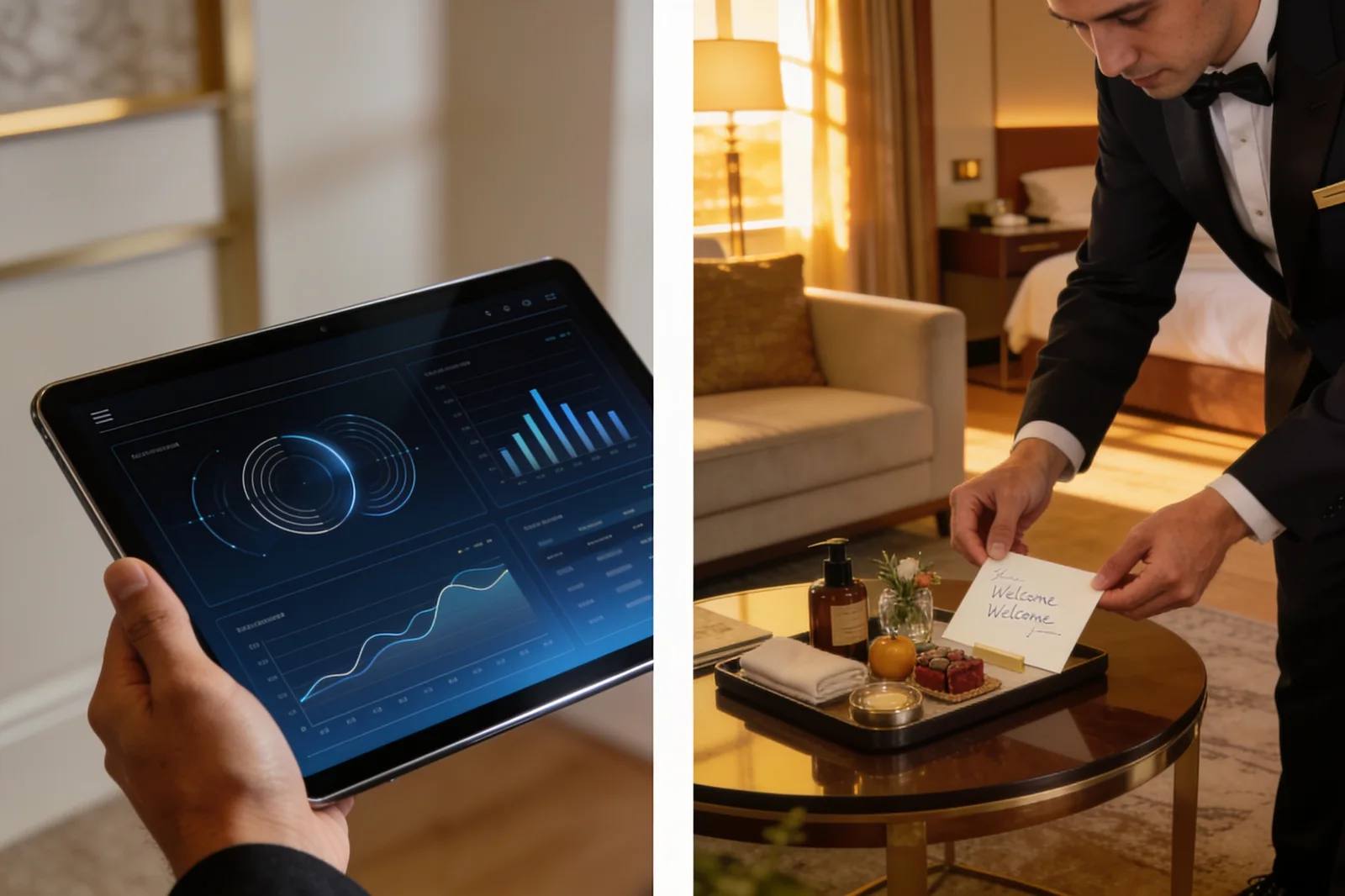
The data on hybrid service models is decisive. A 2026 comparative study published in the Journal of Service Management found AI-only service delivery scored lower satisfaction compared to human-only service. Hybrid configurations, where AI handles backend data processing and pattern analysis while human advisors manage guest-facing communication and judgment, consistently achieved the highest satisfaction and trust scores.
Melissa Krueger, CEO of Classic Vacations, captures this dynamic precisely: "Luxury travelers don't see AI as a substitute for expertise; rather, they expect it to quietly enhance the experience. As AI becomes more prevalent, the value of human connection is actually increasing."
Human judgment remains irreplaceable in three domains:
- Service recovery: When plans fail, empathy and creative problem-solving outperform algorithmic rebooking
- Emotional resonance: Curating moments that carry symbolic or sentimental weight requires cultural fluency and interpersonal perception
- Ethical boundaries: Deciding what personalization is appropriate versus intrusive demands human discretion
The evidence from PhocusWire consistently supports this division of labor: technology for efficiency and scale, humans for trust and creativity.
Capturing subtle guest preferences without overreach
Effective preference capture operates on multiple registers. The explicit layer covers directly communicated needs: dietary restrictions, mobility requirements, celebration purposes. The behavioral layer infers from past choices: a guest who consistently books late breakfast slots likely prefers unhurried mornings. The contextual layer reads situational signals: a traveler checking in after a red-eye flight needs different handling than one arriving midday.
Concrete techniques for professional settings include:
- Structured preference interviewsConduct brief, purposeful conversations at booking or pre-arrival, asking open questions about travel pace, sensory preferences (light levels, sound environments), and past disappointments. Record responses in structured fields that AI systems can parse.
- Dietary nuance documentationMove beyond "vegetarian" or "allergies" to capture intensity, origins, and context. A guest avoids dairy for digestion versus ethical reasons requires different accommodation strategies.
- Aesthetic taste profilingNote responses to design elements, art styles, musical environments, and spatial configurations. These inform room assignment, activity recommendation, and AI concierge deployment parameters.
- Pace calibrationTrack how guests actually use time versus how they planned to. Some travelers over-schedule and under-enjoy; others resist any structure. Adjust future itineraries accordingly.
Navigating privacy and regulatory constraints
Detailed preference collection carries significant legal weight. The EU AI Act, enforceable since August 2, 2026, requires transparent disclosures when hospitality providers deploy AI chatbots, virtual concierges, or synthetic media. Biometric categorization and emotion recognition tools in service settings have been prohibited since February 2025. France's CNIL mandates that sensitive guest preference data, including dietary restrictions, religious requirements, or health profiles, adhere to strict purpose limitation and explicit consent rules under GDPR.
Practical compliance steps for luxury operators:
- Segment preference data by sensitivity tier, with highest protection for health, biometric, and behavioral inference data
- Implement technical controls such as column-level PII masking before AI system ingestion
- Provide clear, non-technical disclosures about how AI contributes to guest service, distinct from general privacy policies
- Establish audit trails for automated decisions that affect guest experience quality or access
These constraints are not merely defensive. Transparent data practices build the trust that enables deeper personalization over time.
Implementing a hybrid planning workflow
A professional framework for combining digital tools with concierge expertise follows a clear sequence:
- AI-assisted discoveryDeploy predictive models to generate initial experience options matched to guest profiles. The system narrows thousands of possibilities to a curated shortlist, ranked by predicted preference alignment.
- Human curation and validationThe concierge reviews AI recommendations, eliminating options that fail emotional or contextual fit tests. This is where knowledge of a guest's unspoken aversions, family dynamics, or current life circumstances shapes selection.
- Collaborative refinementPresent options to the guest with transparent reasoning: "Based on your past preference for intimate dining and your interest in regional ceramics, we selected this private atelier visit with a working potter." This builds trust and invites correction.
- Dynamic executionUse AI monitoring for operational variables (traffic, weather, vendor availability) while the concierge maintains guest communication and handles exceptions.
- Feedback integrationStructure post-experience capture to improve both algorithmic models and human understanding. What landed, what missed, and why.
For properties building this capability, direct booking strategy infrastructure and loyalty retention systems provide the data foundation. The investment in hybrid workflows pays out through repeat booking rates and referral generation that pure automation cannot replicate.
What to implement this quarter
Start with a focused pilot rather than system-wide transformation. Select one guest segment, one destination, or one service category. Map current touchpoints for preference capture gaps. Evaluate existing AI tools against the specific capabilities described here, not generic marketing claims. Most importantly, measure guest-perceived personalization quality, not just operational efficiency.
The competitive advantage in luxury travel experiences increasingly belongs to operators who can make technology invisible and human judgment unmistakable. The tools are now mature enough to support that combination. The discipline to execute it remains scarce.