Cultural travel experiences drive the most significant shift in luxury hotel design since the boutique movement began. Properties embedding local heritage into architecture and guest rituals command rate premiums of 18% to 22%, while superficial styling yields no measurable advantage. This article examines how immersive traditions reshape structural design, interior storytelling, and market positioning across global hospitality.
Defining cultural travel experiences in hospitality
A cultural travel experience involves sustained immersion rather than passive sightseeing. It includes learning regional crafts from practitioners, eating dishes rooted in agricultural history, and staying in spaces built from local materials by local hands. For luxury hospitality, this definition changes how properties are conceived.
American Express Travel research indicates that 83% of Millennial and Gen Z travelers prioritize unique, authentic experiences over traditional tourist attractions. This demographic shift pushes hoteliers to consider whether a property can deliver emotional resonance alongside service excellence. The answer lies in design that makes the building a participant in cultural transmission.
The distinction between themed and culturally integrated design is critical. Themed hotels apply surface decoration, such as patterned carpets or carved masks. Culturally integrated properties embed regional logic into structural decisions. A Moroccan riad’s inward-facing courtyard with a central fountain responds to climate, family privacy customs, and Islamic garden philosophy. Replicating that spatial flow requires understanding its origin, not just its appearance.
Architectural adaptation from heritage to habitat
Leading luxury properties adapt existing structures or construct new ones using vernacular techniques emerged from specific cultural and environmental conditions. This represents a departure from imported opulence that dominated luxury hospitality for decades.
In Japan, Bjarke Ingels Group completed NOT A HOTEL Setouchi on Sagishima island in 2026 using site-excavated rammed earth walls and Yakisugi, the traditional charred cedar technique. Ryohei Koike, Associate at BIG and Design Lead for the project, stated: "Rammed earth felt like a very natural choice because we wanted the architecture to feel as if it had grown out of Sagishima's landscape, rather than simply being placed on top of it. We chose rammed earth not only for its material beauty, but because it helped root the project physically and emotionally in its setting."
In Mexico's Yucatán Peninsula, renovations of historic haciendas and new boutique resorts center on ancient Mayan Chukum plaster. Derived from boiling the bark resin of the endemic Havardia albicans tree mixed with hydrated lime and sascab limestone dust, this technique provides natural waterproofing, microbial resistance, and organic thermal regulation. First revived during henequen hacienda restorations, Chukum has become an international hallmark of warm, minimalist luxury interiors.
Across Saudi Arabia and the UAE, regional desert architecture incorporates local sandstone, rammed earth, and traditional courtyard configurations rather than mirrored glass or imported gilded marble. These choices reflect environmental logic and cultural continuity. Courtyard layouts moderate temperature extremes while honoring privacy-oriented spatial traditions of Arabian domestic architecture.
Interior design as cultural storytelling
When cultural travel experiences inform interior design, the result is environments that feel native rather than imported. This requires sourcing that mirrors specific cultural rituals and aesthetic movements, avoiding generic ethnic styling.
Local artisans and craftsmen occupy a central role in this process. Successful properties establish direct collaboration with regional craft guilds and individual practitioners. The Kilohana Cultural Resource Center at Grand Wailea in Hawaii, which hosted over 6,000 visitors in 2026, exemplifies this operational model. It functions as a living cultural hub where guests engage with Hawaiian history, crafts, and lessons rather than observing static displays.
Textiles present a clear illustration. A property in Oaxaca might commission rugs from Zapotec weavers using natural dyes and traditional pedal-loom techniques, with patterns specific to the weaver's village. The provenance is documented and shared with guests. This contrasts with purchasing mass-produced Southwestern textiles from a commercial distributor. The former carries cultural weight and supports craft continuity. The latter is decoration without narrative.
Furniture and spatial arrangements follow similar logic. Japanese ryokan-inspired minimalism in contemporary luxury properties reflects specific cultural values: the primacy of seasonal awareness, the ritual of tea preparation, and the distinction between omote (public face) and ura (private self). Successful adaptations translate these concepts into functional hospitality spaces rather than copying visual stereotypes.
Global examples of culturally driven design
Several completed and operating properties demonstrate how cultural travel experiences translate into coherent design identities.
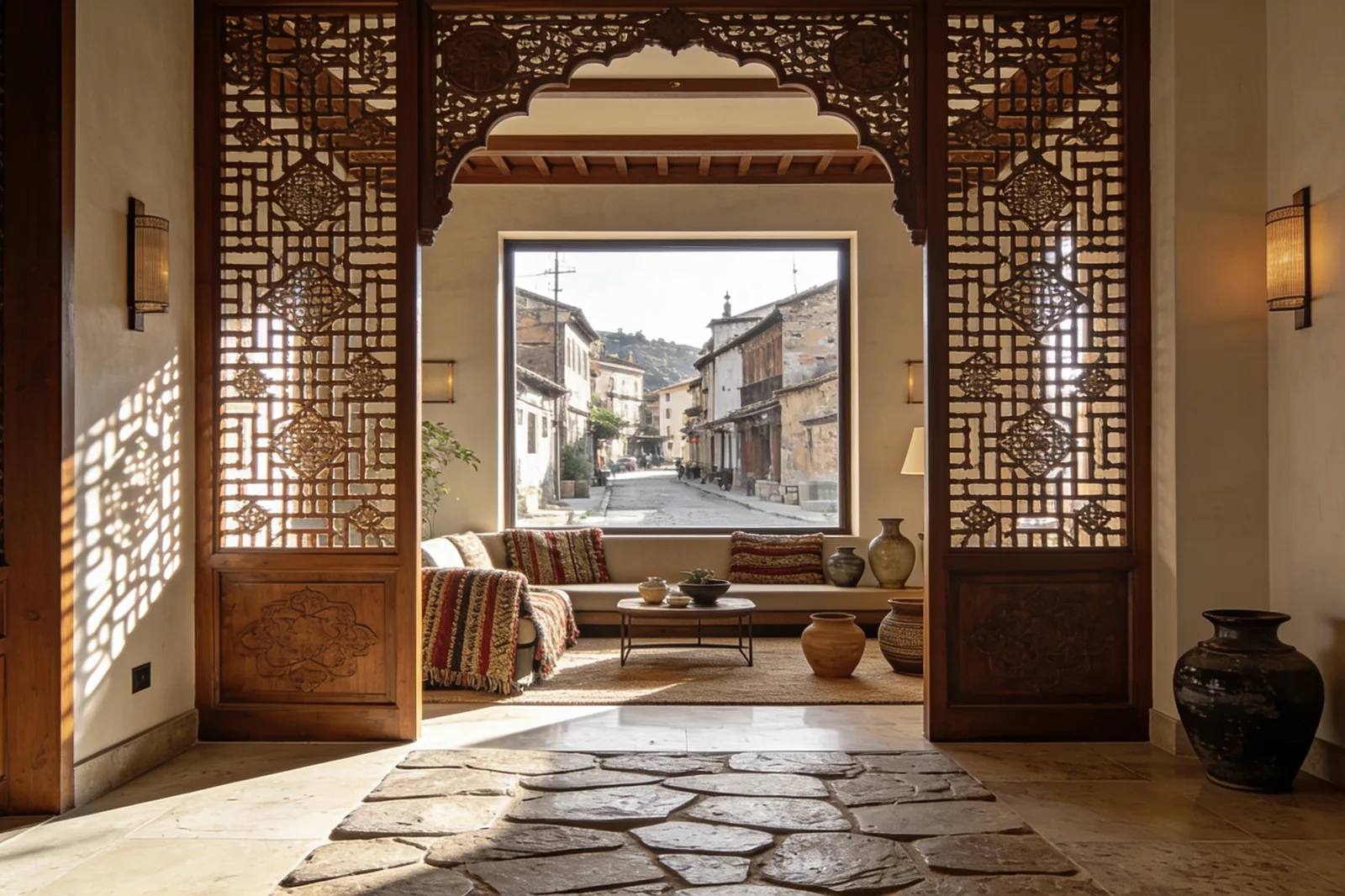
In Morocco, luxury properties drawing on riad traditions employ central courtyards with water features that cool air through evaporation, zellige tilework from Fez workshops, and mashrabiya screens that filter light while preserving privacy. The spatial flow follows traditional patterns: progression from public reception areas through increasingly private domestic spaces, culminating in roof terraces with panoramic views.
Japanese properties influenced by ryokan culture emphasize tatami mat proportions, tokonoma alcoves for art display, and ofuro bathing rituals. Contemporary interpretations by firms like BIG maintain these experiential anchors while updating material palettes and structural systems.
Mexican properties in the Yucatán region integrate Chukum plaster surfaces, henequen fiber textiles, and restored colonial architectural elements. The design narrative connects guests to the region's layered history: Mayan agricultural practices, Spanish colonial intervention, and twentieth-century henequen boom architecture.
Impact on guest satisfaction and market positioning
Culturally resonant design produces measurable commercial outcomes. A 2026 Arthur D. Little study across Saudi Arabia and the UAE found that properties incorporating architectural authenticity, heritage, and regional traditions achieved an average 5% uplift in occupancy, higher average daily rates, stronger revenue per available room, and Net Promoter Scores above global benchmarks.
Cultural hospitality is no longer a decorative layer, it's a strategic driver of value. We found that properties rooted in authentic storytelling and design not only delight guests but also command stronger performance metrics across the board.
Ichrak Hadj Aissa, Principal at Arthur D. Little
The mechanism is emotional connection. Guests who experience a property as a genuine expression of place report higher satisfaction and return intention. This translates directly into loyalty retention metrics that outperform properties competing on amenities alone.
However, cultural positioning does not drive advantages universally. In corporate business corridors where travelers prioritize loyalty points, transit proximity, and predictable standard amenities, local storytelling carries less weight. The strategy succeeds most clearly in leisure-driven and mixed-use luxury markets where guests actively seek destination-specific experiences.
Digital marketing increasingly highlights these cultural design elements to attract niche audiences. Properties showcase artisan collaborations, material sourcing stories, and architectural lineage through video documentation and immersive online content. This content strategy targets travelers who research extensively before booking and who use cultural authenticity as a filter in property selection.
Sustainability and hyper-localism as future directions
The next phase of culturally driven luxury hotel design tightens the connection between ecological responsibility and cultural preservation. This involves sourcing materials from immediate bioregions, employing construction techniques with low embodied carbon, and designing for climate adaptation using traditional knowledge systems.
Guy Cooke, Studio Director of WATG Advisory for Asia Pacific and Middle East, observed: "As travelers continue to prioritize meaningful, emotionally resonant experiences, the market is shifting toward concepts that blend creativity, commercial performance, and a deeper sense of place."
The living heritage concept is gaining traction. Rather than preserving culture as museum display, design supports ongoing cultural practice. Properties host resident artisans, fund craft guild apprenticeships, and integrate seasonal rituals into guest programming. The building becomes infrastructure for cultural continuity, not merely a container for cultural reference.
Post-pandemic shifts reinforce this direction. Travelers who spent extended periods in restricted conditions emerged with heightened interest in meaningful engagement and reduced tolerance for superficial consumption. Properties that had invested in genuine cultural integration were positioned to meet this demand without strategic pivot.
Evaluating properties and planning development
For travelers seeking authentic cultural travel experiences, several indicators distinguish genuine integration from marketed decoration. Ask specific questions before booking: Are local artisans named and credited? Does the property document material provenance? Is cultural programming led by community practitioners or hotel staff in costume?
For hoteliers considering this direction, the investment is front-loaded. Authentic relationships with craft communities, vernacular material sourcing, and heritage-sensitive architecture require longer development timelines than standard international hotel construction. The return manifests in rate premiums, guest loyalty, and resilience against market commoditization.
For design professionals, the skill set expands beyond aesthetic competence to ethnographic sensitivity and supply chain innovation. Success requires understanding cultural context deeply enough to make appropriate structural decisions, not merely select appropriate finishes.
Properties exploring this path should see the services available for developing culturally grounded hospitality concepts, from initial community engagement through digital storytelling strategy. The competitive landscape for luxury hotels increasingly rewards those who build genuine place-based identity rather than efficient international standardization.