Optimizing Dubai hotel websites for user experience is the single most effective way to reduce reliance on OTAs and capture direct bookings. In a market where guests research on smartphones but complete high-value transactions on desktop, your site must deliver frictionless performance across every device, load in under 2.5 seconds, and speak directly to regional traveler expectations. The hotels that win direct revenue treat their websites as booking engines, not digital brochures.
Why optimizing dubai hotel websites for user experience drives direct bookings
Direct bookings remain a minority channel for most hotels. Industry analysis from Hospitality Net shows that properties typically capture only 5% to 15% of total reservations through their own websites versus OTAs. The gap is not primarily about price. It is about trust and friction.
Guests abandon direct bookings when checkout feels harder than third-party alternatives. Common failure points include mandatory account creation before payment, unexpected fees revealed only at the final step, and redirects to visually mismatched booking engine subdomains. Travel Marketing News confirms that the primary cause of direct booking abandonment is checkout friction rather than pricing.
You can order take out, a taxi, or a week's worth of groceries with one tap. So why does booking a hotel room still feel like filling in a tax return?
Frédéric Robles, Founder, Namastay
For Dubai's luxury market, the stakes are higher. Room rates run significantly above global averages, and guests researching five-star properties expect digital experiences that match the physical ones. A clunky booking flow signals operational mediocrity before the guest ever arrives.
Properties looking to benchmark their competitive positioning can See hotels in Dubai to understand how leading properties structure their presentation and booking pathways.
Mobile-first design for the modern Dubai traveler
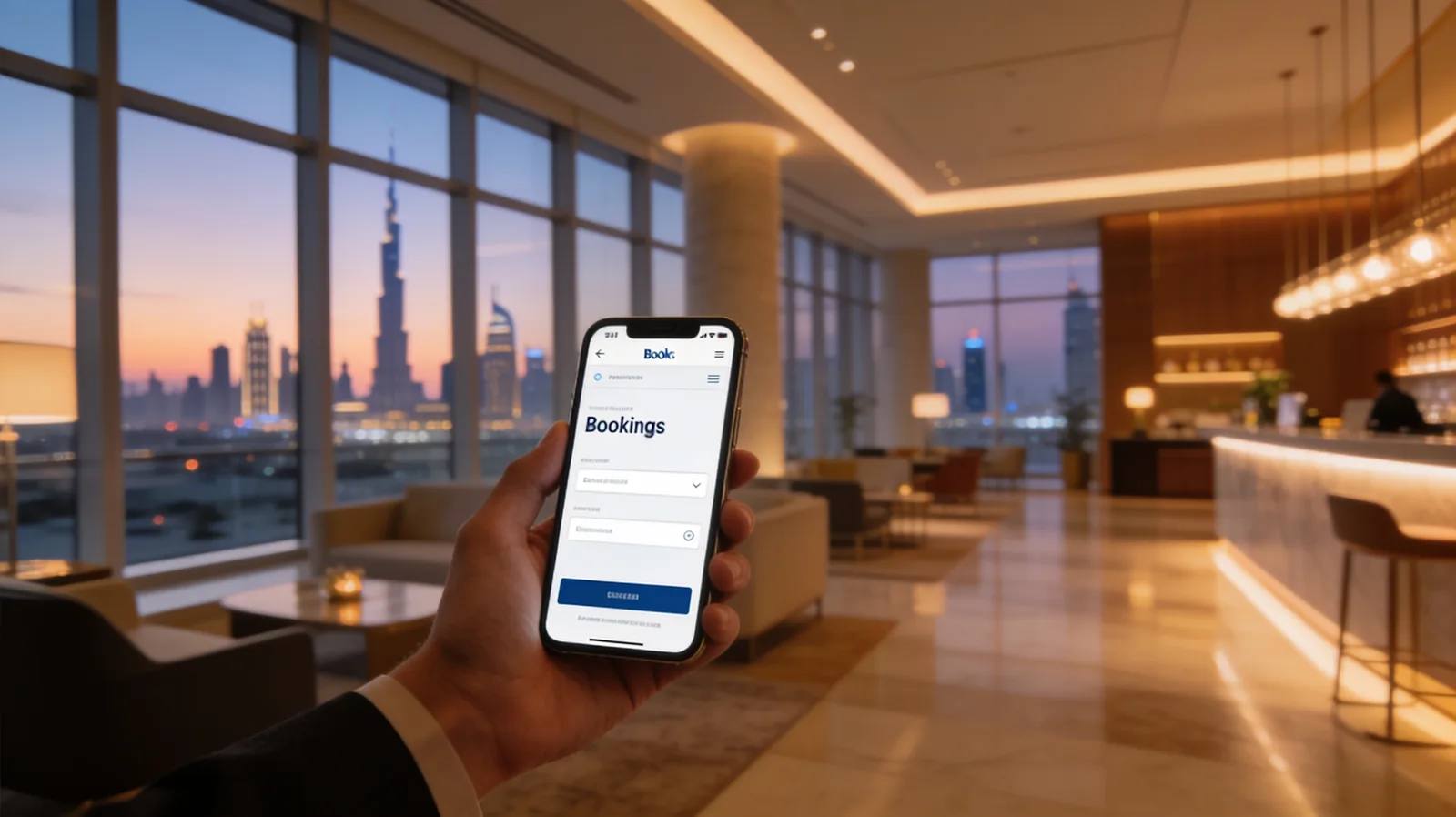
Mobile devices dominate hotel discovery, though the booking journey often crosses devices. In the UAE and broader GCC, mobile platforms represent between 60% and 63% of digital travel bookings. Global data from Fortune Business Insights puts mobile's share of online accommodation bookings at 61.45% worldwide.
However, luxury hospitality exhibits a distinct cross-device pattern. Over 60% to 70% of exploratory traffic originates on smartphones, but desktop platforms retain higher transaction completion rates. Complex rate structures, room comparison needs, and user hesitancy to enter credit card details on handheld screens drive this behavior.
The UAE's median mobile download speed of 761.17 Mbps, confirmed by Ookla as the world's fastest, creates a paradox. Guests are accustomed to instant digital experiences everywhere else in their lives. A hotel site that stutters or lags feels uniquely broken by comparison.
Practical mobile priorities for Dubai hotels include thumb-friendly navigation with targets no smaller than 48 pixels, sticky booking buttons that remain accessible during scroll, and calendar pickers optimized for touch rather than mouse interaction. Forms must minimize typing; auto-fill compatibility and digital wallet integration are baseline expectations, not premium features.
Streamlining navigation and search functionality
Guests decide within seconds whether your site can deliver what they need. Confusing navigation sends them back to Google, and from there to an OTA with cleaner information architecture.
Effective room search requires filterable parameters that match how travelers actually choose: occupancy, view category, bedding configuration, and accessibility features. Availability calendars should default to the current date with clear visual indicators for sold-out nights. Rate displays must show total pricing inclusive of taxes and fees at the listing stage, not hide them until checkout.
Call-to-action placement follows predictable gaze patterns. Primary booking buttons belong above the fold on every room detail page, repeated at natural decision points throughout the scroll. Effective CTAs for luxury properties include "Check Availability," "Reserve Your Stay," and "View Exclusive Rates." Vague labels like "Learn More" or "Submit" perform poorly because they fail to signal the next step's value.
Properties refining their direct booking strategy can explore direct booking strategy approaches tailored to their market position.
One persistent error is burying the booking engine behind multiple clicks. The path from homepage to date selection to room selection to payment should require no more than four steps, with progress indicators visible throughout.
Localized content: language and cultural nuances
Dubai's visitor base demands genuine bilingual capability, not automated translation widgets. Arabic-speaking guests from the GCC represent a high-value segment, and their booking experience must feel native.
Comprehensive Arabic localization requires bidirectional Right-to-Left (RTL) interface engineering. Improper handling of mixed-direction text, such as Latin brand names or numeric prices alongside Arabic descriptions, creates layout breaking and visual mistrust. Navigation hierarchies, iconography, and form field ordering must all reverse coherently.
Seasonal content adaptation is equally critical. During summer heat (June to September), websites should foreground temperature-controlled pools, indoor dining, luxury spas, and family staycation packages. Ramadan requires adjusted dining hours, Iftar and Suhoor culinary experiences, and flexible check-in policies. Winter peak season (October to April) shifts emphasis to outdoor venues, beach clubs, and events like the Dubai Shopping Festival.
Imagery must reflect regional cultural norms. Pool and beach photography should include modest swimwear options or private cabana settings alongside international resort-style shots. Family-oriented content should show multi-generational travel, a common GCC pattern.
For deeper perspective on how cultural context shapes hospitality presentation, see how cultural travel experiences shape luxury hotel design.
Speed optimization: the hidden conversion killer
Page speed is not a technical vanity metric. It is a direct revenue variable. Google's Core Web Vitals define three measurable standards: Largest Contentful Paint (LCP) must occur within 2.5 seconds, First Input Delay (FID) must stay below 100 milliseconds, and Cumulative Layout Shift (CLS) must remain under 0.1. These metrics determine both search ranking and user retention.
HOHEIT's research confirms the 2.5-second LCP threshold, while Strathcode documents that bounce probabilities increase by 32% as load times move from 1 second to 3 seconds. Deloitte's research with Google found that improving mobile site speed by just 0.1 seconds yields an 8% to 10% conversion lift on travel websites.
Speed's impact on mobile bounce probability
High-resolution hotel photography presents a specific optimization challenge. The solution is not smaller images but smarter delivery. Implement responsive images with srcset attributes serving appropriately sized files per device width. Use modern formats: WebP with JPEG fallbacks, or AVIF where browser support permits. Lazy-load images below the fold. Set explicit width and height attributes to prevent layout shift.
Server response matters for global visitors accessing Dubai-hosted sites. Content delivery networks (CDNs) with edge nodes in Europe, Asia, and North America reduce latency for source markets. Database query optimization for real-time availability checks prevents booking engine slowdowns during peak traffic.
Properties assessing their technical foundation can See hotels in Dubai to evaluate how top performers balance visual richness with sub-2.5-second delivery.
Measuring success: key UX metrics for hotels
Optimization requires measurement. The following metrics reveal where guests abandon and where investment returns highest:
| Metric | What it reveals | Target benchmark |
|---|---|---|
| Bounce rate | Percentage of single-page sessions with no interaction | Low percentage for landing pages |
| Time on page | Engagement depth with content and imagery | 2+ minutes for room detail pages |
| Pages per session | Navigation breadth and content relevance | 3+ for research-stage visitors |
| Booking funnel completion | Step-by-step abandonment in reservation flow | Above 15% from cart to confirmation |
| Core Web Vitals LCP | Perceived load speed of largest visible element | Under 2.5 seconds |
Conversion funnel analysis is the highest-leverage activity. Map the exact steps from homepage entry to booking confirmation. Identify the step with the largest drop-off. Fix that step before optimizing anything else. Common failure points include date selection (unclear availability), room comparison (insufficient differentiation), and payment (unexpected fees or missing wallet options).
Heat mapping and session recording tools reveal behavioral patterns quantitative data misses. Watch real users struggle with your calendar picker or hunt for your phone number. These observations generate faster fixes than aggregate metrics alone.
For hotels integrating measurement with broader guest experience strategy, AI integration in hotel services offers complementary approaches to personalization and predictive analytics.
Simplifying the booking engine interface
The booking engine itself is where direct revenue is won or lost. Industry data shows that lacking instant digital wallet checkout forces manual card entry on touchscreens, causing up to 80% abandonment at the reservation gate.
Essential simplifications include: eliminating mandatory account creation (guest checkout as default), displaying all fees inclusive from the first rate view, preserving visual brand continuity by avoiding third-party subdomain redirects, and offering Apple Pay, Google Pay, and regional wallets like Samsung Pay and stc pay.
Calendar interfaces deserve particular scrutiny. Default to today's date, block past dates, highlight minimum stay requirements dynamically, and show rate fluctuations visually. Mobile calendar pickers should use native OS components where possible rather than custom JavaScript implementations that break touch behavior.
Post-booking confirmation must be immediate and informative. Include reservation details, cancellation policy, property contact, and local arrival guidance. This reduces anxiety-driven cancellation and customer service inquiries.
Your next steps: a 30-day UX action plan
- Audit current performanceRun your site through Google PageSpeed Insights and Lighthouse. Record Core Web Vitals scores, identify LCP elements, and flag layout shift issues. Benchmark against three competitor properties.
- Map the booking funnelIn Google Analytics 4, create a funnel exploration from homepage to booking confirmation. Calculate abandonment rate at each step. The largest drop-off is your first priority.
- Implement mobile fixesIncrease touch targets to 48px minimum, add sticky CTAs, enable auto-fill, and test calendar pickers on actual iOS and Android devices, not just browser emulators.
- Optimize image deliveryConvert hero images to WebP with JPEG fallbacks. Implement responsive srcset. Lazy-load below-fold content. Set explicit dimensions to eliminate CLS.
- Add digital wallet checkoutContact your booking engine provider to enable Apple Pay, Google Pay, and regional wallets. This single change can double mobile completion rates.
Properties ready to advance their direct booking capability should see the services available for comprehensive website optimization and conversion strategy.
Monitor results weekly, not monthly. Speed improvements and funnel fixes produce measurable changes within days. The hotels that treat UX as a continuous operational discipline, not a one-time redesign, build sustainable direct revenue that OTAs cannot intercept.
Travelers exploring options can See hotels in Dubai to experience how optimized properties present their offerings and streamline their booking pathways.