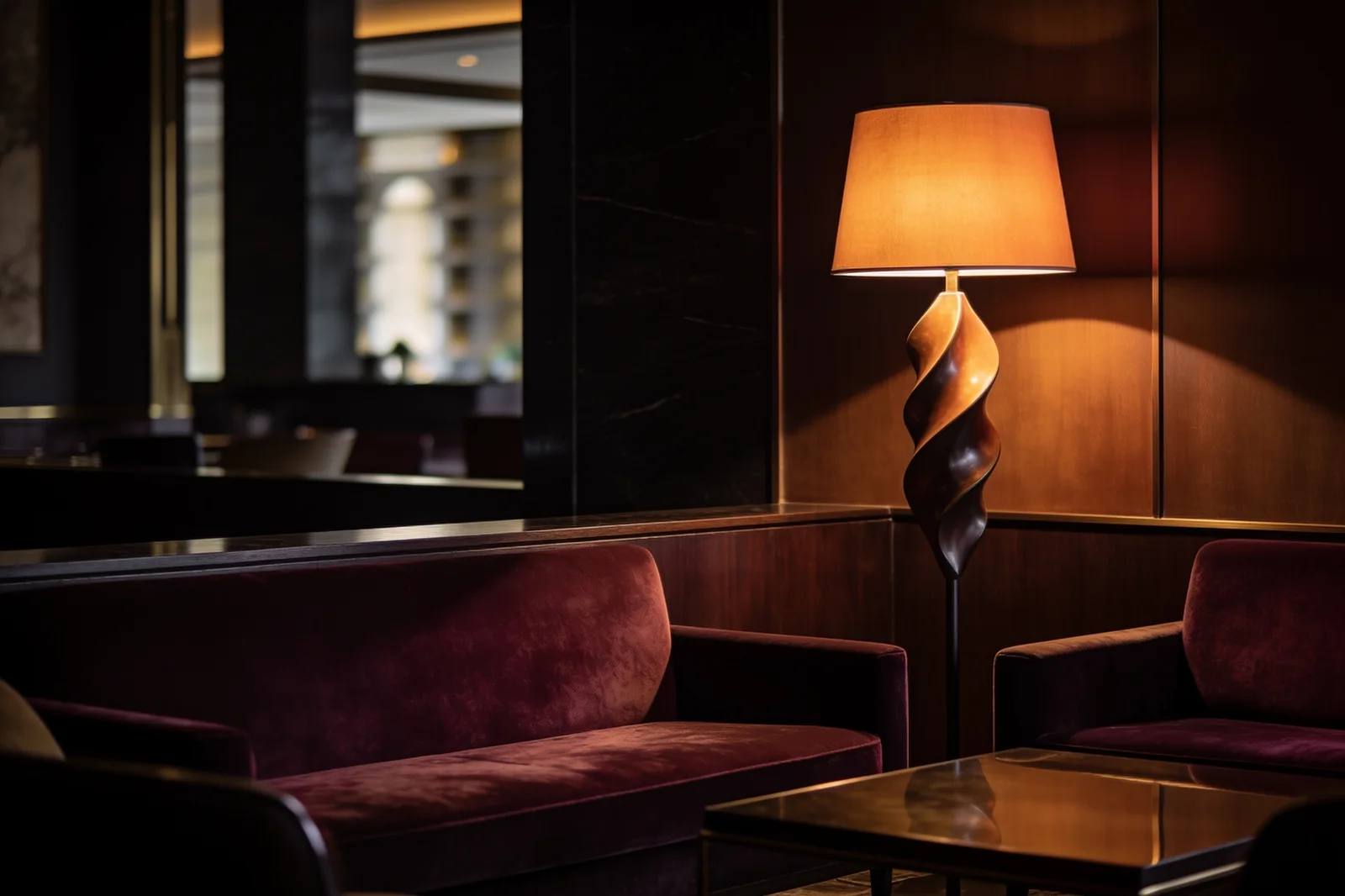
Luxury hotel atmosphere curation is the intentional engineering of every sensory touchpoint to produce a specific emotional response that reinforces brand identity. Unlike standard interior design, which treats visual aesthetics as the primary goal, this discipline orchestrates light, sound, scent, material texture, and spatial narrative into a unified experience guests feel before they consciously register it.
Atmosphere Curation Versus Standard Interior Design
Interior design selects furniture, palettes, and finishes. Atmosphere curation asks what a guest should feel at 3:00 p.m. in the lobby, at 11:00 p.m. in the corridor, or at 7:00 a.m. at the bathroom vanity. The distinction is operational rather than semantic. Design remains static; atmosphere responds to time and context.
The Pivotal Hospitality Design Editorial Team notes: "The result feels genuinely rooted rather than themed... Theming applies a superficial overlay of decorative motifs; narrative-driven design connects the physical environment to the property's location, history, brand identity, or aspirational positioning." A themed hotel can be lifted and dropped in another city intact. A curated atmosphere collapses if displaced, because its materials, light quality, and acoustic profile are inseparable from place.
This rootedness translates into commercial performance. Research published by the Cornell University School of Hotel Administration demonstrates that a 1-point increase in a property's Global Review Index enables a hotel to increase its Average Daily Rate (ADR) by 0.89% while preserving occupancy, yielding a 1.42% increase in Revenue Per Available Room (RevPAR). Guest perception of physical ambiance anchors this index heavily.
The Visual Layer: Lighting, Color, and Materiality
Lighting temperature and intensity regulate circadian expectation, perceived warmth, and spatial hierarchy. Luxury hotel lighting standards specify correlated color temperatures between 2700K and 3000K in lobbies to establish an inviting arrival atmosphere. Automated DALI-2 scene control and dim-to-warm drivers then shift lobbies to 2200K or 2400K in evening hours, signaling a transition from public energy to private intimacy.
| Zone | Color Temperature (CCT) | Ambient Illuminance | Special Requirements |
|---|---|---|---|
| Lobby (day) | 2700K, 3000K | 200–300 lux at reception | Tunable white, automated scenes |
| Lobby (evening) | 2200K, 2400K | 100–150 lux in seating areas | Dim-to-warm drivers |
| Guest room (ambient) | 2700K | Variable by scene | Night navigation paths at 2000K, 2200K |
| Guest room (vanity) | 2700K, 3000K | Task-focused | CRI 90+ for color accuracy |
| Guest room (work desk) | 3000K, 4000K | Isolated task zone | Contained to prevent sleep disruption |
In guest rooms, ambient and bedside fixtures typically sit at 2700K or lower. Night navigation paths use 2000K to 2200K light to prevent blue-light disruption to melatonin secretion. Vanity mirrors require high color rendering index (CRI 90+) at 2700K to 3000K. Work desks may use up to 4000K for task focus, but must remain contained so the guest does not carry that alertness to bed.
Materiality extends this thermal logic. Wood, stone, and textiles absorb and reflect light differently than polished synthetics. Tactile materials age visibly, acquiring patina that signals authenticity. Architect Charles Zana describes his approach to Riviera properties as "mixing objects in wood with terracotta and ceramic tiles... designed with the idea that there's a new way of seeing the French Riviera that is not kitschy, but modern." The material choice is inseparable from the emotional program.
Auditory and Olfactory Branding
Noise is the most frequent complaint in luxury accommodations. Empirical studies establish that perceived acoustic quality holds a high positive correlation (r = 0.815, p < 0.001) with guest-perceived luxury and spatial value. Intentional soundscaping, biophilic masking, calibrated reverberation absorption, and psychoacoustically engineered playlists extend dwell time and satisfaction. In dining outlets, elevated noise levels impair sensory flavor perception directly.
Olfactory branding operates on a longer memory arc. The olfactory bulb connects directly to the amygdala and hippocampus, bypassing the thalamic relay that processes other senses. A signature scent anchors brand recognition with minimal conscious processing.
Leading boutique hotels have systematized this. EDITION Hotels partnered with Le Labo to craft an exclusive black tea and bergamot signature scent, distributed via central HVAC diffusion and custom guestroom amenities. Ian Schrager pioneered this model at New York's Gramercy Park Hotel in 2006, where Le Labo founders developed 'Cade 26' around the lobby hearth: wood smoke, leather, and amber. Dawn Goldworm, Co-Founder and Olfactory Director at 12.29, describes the intended effect: "The vision was sinking into a worn-in leather chair in the lounge with a glass of scotch. Warm, inviting, comfortable, sexy and modern."
Similar programs include Le Méridien's 'LM002' (vintage library parchment and leather) and 1 Hotels' custom cedarwood and eucalyptus blends reflecting biophilic positioning. The scent serves as a structural brand element with distribution infrastructure.
Narrative Integration: Storytelling Through Space
A curated atmosphere tells a story without explanatory plaques. The narrative emerges from material provenance, craft technique, and spatial sequence. Cultural luxury hotels integrate local artisan millwork, indigenous materials, and responsive circadian light so that the guest experiences the place's identity through the body, not just the eye.
Effective narrative integration follows three principles. First, specificity over generality: a Portuguese property uses cork from a particular Alentejo farm, not "Portuguese cork" as a category. Second, temporal layering: the story includes what existed before the hotel, what was preserved, and what was added. Third, spatial progression: the narrative unfolds as the guest moves. The arrival sequence, corridor transition, room threshold, and window prospect each deliver a different chapter.
Properties like Miami's design-forward boutique hotels demonstrate how regional narrative can be embedded without cliché. The art program references local makers. The color palette derives from specific environmental conditions: salt oxidation, coral stone, mangrove shadow. The result is recognizable as place without being literal.
The Role of Technology in Enhancing Ambiance
Post-2024 luxury hospitality has shifted decisively toward invisible technology. The prior generation's in-room tablets and conspicuous touchscreens are being deprecated in favor of concealed infrastructure. This paradigm, termed 'invisible techspitality,' embeds functionality behind flush millwork: subsurface wireless charging, embedded plaster-mount keypads, invisible architectural speakers, and passive environmental IoT sensors.
Smart controls now grant guest agency without visual intrusion. Lighting scenes adjust automatically to circadian rhythm, but guests retain override capacity through interfaces that do not announce themselves as technology. Climate systems respond to occupancy and air quality data from hidden sensors. Biophilic integration extends to architectural wellness infrastructure: mass timber construction, air purification filtration, and dynamic circadian lighting schemes that adjust CCT across the day.
Technology that guests must look at disrupts atmosphere. Technology that operates without their attention preserves it. Properties seeking to implement this shift can see the services available for atmospheric technology integration.
Case Studies in Successful Atmosphere Curation
EDITION Hotels, the collaboration between Marriott International and Ian Schrager launched in 2010, standardizes atmosphere through controlled sensory variables. The Le Labo scent partnership, the calibrated acoustic profile of public spaces, and the consistent lighting temperature program create recognizable environmental DNA across properties in different cities. Each location adapts materiality and art to place, but the atmospheric grammar remains constant. Guests who have stayed in one EDITION recognize another before they identify why.
1 Hotels pursues a different atmospheric proposition: biophilic wellness as luxury. Custom cedarwood and eucalyptus scent blends, living plant walls integrated into structural design rather than applied as decoration, and circadian lighting programs that track natural daylight progression communicate health and environmental consciousness without didactic signage.
Independent properties achieve comparable coherence through stricter curation. The Hoxton's varying locations each establish distinct atmospheric identities through localized narrative programs, unified by consistent spatial typologies: the residential-style lobby, the restaurant as social anchor, the bedroom as restrained refuge. Guests choose a Hoxton location for its specific atmosphere.
For travelers evaluating atmospheric quality before booking, Zürich's architecturally significant hotels offer a useful reference set, as do Dubai's design-led boutique properties.
Measuring Impact: How Atmosphere Drives Direct Bookings
Atmospheric investment produces measurable returns. The Cornell research establishing 0.89% ADR growth and 1.42% RevPAR growth per review-index point provides a baseline. Hospitality research on biophilic and multisensory architectural interventions demonstrates that enhanced atmosphere commands guest willingness-to-pay rate premiums between 10% and 18%.
Atmospheric Impact on Revenue Metrics
Organic social media sharing amplifies this effect. Guests photograph and share environments that produce strong emotional responses. Properties with coherent atmospheric programs generate higher volumes of unprompted visual content, reducing customer acquisition costs for direct bookings. The atmosphere becomes a marketing asset that operates without campaign spend.
Guest retention follows. Atmospheric consistency builds expectation. Guests who experienced a specific sensory environment return to re-experience it, or seek the same brand in new locations. This is particularly valuable for independent properties without loyalty program infrastructure. The atmosphere itself becomes the loyalty mechanism.
Auditing Your Property's Sensory Elements
Hoteliers can assess their current atmospheric curation through systematic sensory auditing. The following framework isolates each channel for independent evaluation, then tests integration.
- Map the guest journey by time and spaceDocument every transition point from reservation confirmation through departure: pre-arrival communication, approach, entry, lobby, vertical circulation, corridor, room entry, room zones, bathroom, departure. Note the dominant sensory channel at each point.
- Measure lighting temperature and intensityUse a color temperature meter and lux meter at each journey point. Compare against specifications: 2700K (3000K in lobbies, 2200K) 2400K for evening transition, 2700K in guest room ambient, CRI 90+ at vanities. Identify zones where measured values contradict intended mood.
- Assess acoustic profileRecord decibel levels and reverberation times in public spaces, corridors, and guest rooms at different hours. Identify noise intrusion paths and masking deficiencies. Test whether dining areas support conversation without strain.
- Evaluate olfactory presence and consistencyDocument scent sources, distribution method, intensity variation by zone, and persistence over time. Determine whether the property has a signature scent or merely cleanliness masking. Test whether the scent program extends to amenities and departure touchpoints.
- Audit material and narrative specificityCatalog materials by origin, craft technique, and regional relevance. Test the displacement question: if this interior were moved to a different city, would its narrative coherence survive? Identify generic or replicable elements that weaken rootedness.
- Review technology visibilityInventory all guest-facing technology interfaces. Classify each as visible (tablet, touchscreen, exposed sensor) or concealed (embedded control, passive sensor, flush mount). Prioritize concealment of high-frequency interaction points.
- Synthesize and prioritize interventionsIdentify the sensory channel with the largest gap between current state and atmospheric intention. Sequence investments by guest journey priority, not by installation convenience. A flawed arrival sequence undermines room investment; fix entry before bedroom.
Properties seeking to strengthen their direct booking performance through atmospheric investment can also review strategies for elevating hotel website user experience, ensuring that digital touchpoints match the sensory promise of the physical environment.
What to Watch in Luxury Hotel Atmosphere Curation
Three trajectories are reshaping luxury hotel atmosphere curation in 2026. First, acoustic soundscaping is moving from spa amenity to core building infrastructure, with wellness and acoustic design forecast by Wimberly Interiors and Gensler as baseline requirements. Second, biophilic integration is deepening from decorative plant placement to structural material choices: mass timber, natural ventilation pathways, and daylight-mimicking circadian controls. Third, guest agency is expanding through invisible interfaces that permit personalization without visual intrusion.
Properties that treat atmosphere as a fixed capital investment rather than a living system will lag. The most successful boutique hotels revisit their sensory programs seasonally, testing guest response and adjusting intensity, sequence, and narrative emphasis. Atmosphere curation is an operational discipline.