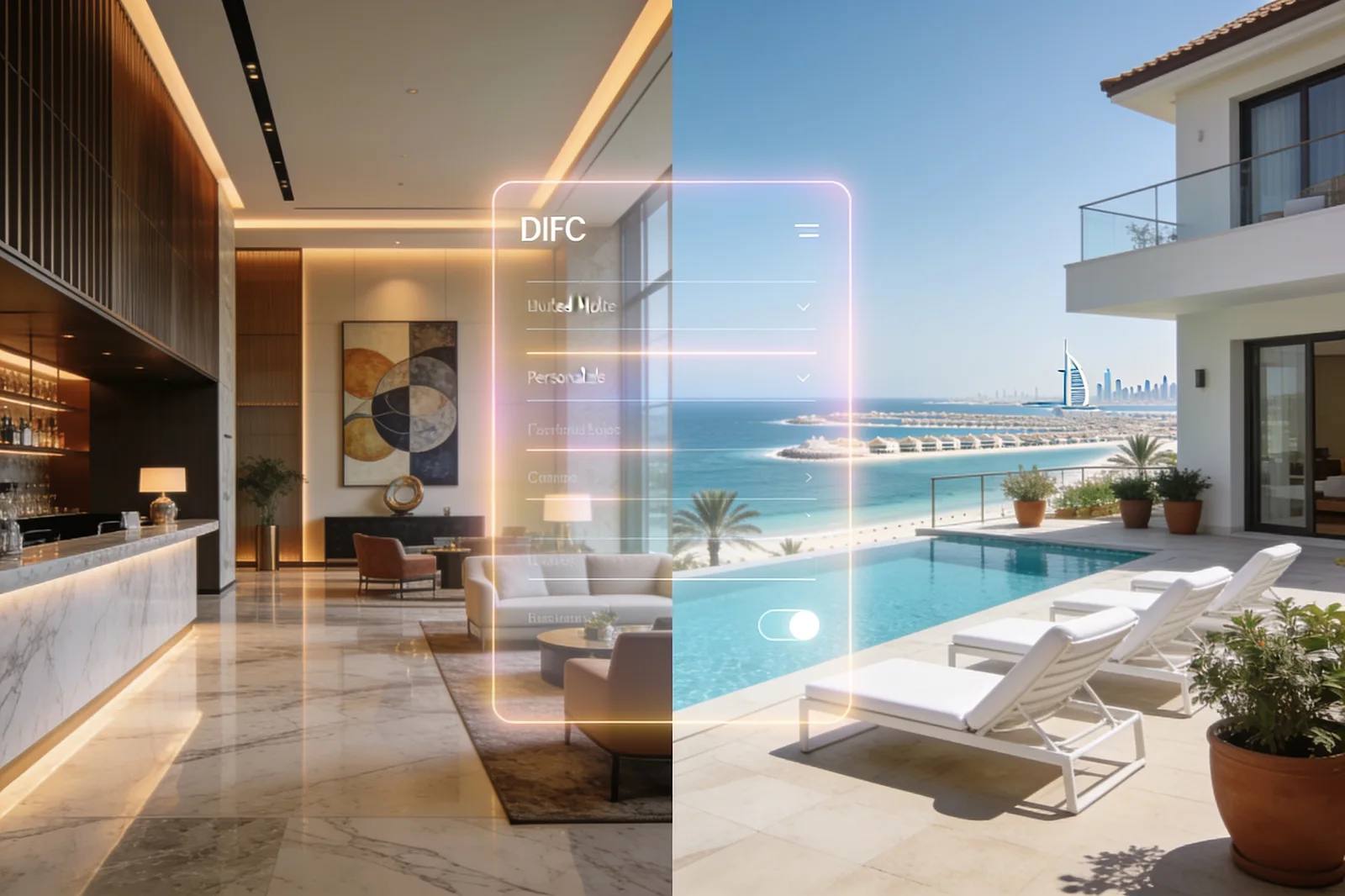
Curated Dubai hotel collections match travelers with stays that fit their personal style, pace, and purpose by organizing properties around neighborhood character rather than star ratings alone. Unlike generic booking filters that sort by price and amenities, curation weighs architectural integrity, service philosophy, and local immersion to produce shortlists where every property earns its place. For high-net-worth travelers who already know Dubai's major districts, this approach turns location from a logistical detail into the defining feature of the trip.
What curated Dubai hotel collections mean
Standard online booking platforms filter by price range, guest rating, and amenity checkboxes. Hotel curation starts from the opposite direction: a human expert or trained system evaluates whether a property's design, atmosphere, and service ethos belong together in a coherent collection. The result is not every hotel that meets minimum standards, but a deliberately short list where each option represents a distinct interpretation of what that neighborhood offers.
A traveler searching for a DIFC stay through conventional filters might see dozens of properties ranked by review score. A curated collection might surface only six, each chosen because its architecture, dining program, or proximity to the Gate Village art district serves a specific traveler persona. The curated list sacrifices comprehensiveness for relevance.
This distinction matters most for repeat luxury travelers who have learned that a 5-star rating in Dubai can describe anything from a large beach resort to a small design hotel with a private art collection. Curation answers the question that star ratings cannot: what will it feel like to stay here?
Why neighborhood defines the experience
Dubai's districts function as distinct travel destinations rather than interchangeable addresses. Downtown and the Burj Khalifa district center on vertical scale, iconic architecture, and immediate access to the Dubai Mall and the opera district. The atmosphere is energized, walkable in pockets, and visually dramatic. Palm Jumeirah offers seclusion, private beachfront, and resort pacing deliberately removed from urban intensity. DIFC combines financial district efficiency with concentrated gallery and restaurant culture, producing a hybrid environment suited to business-leisure travelers who want cultural access without resort isolation. Jumeirah, the older coastal strip, maintains lower density, established landscaping, and proximity to local institutions rather than global landmarks.
These differences are not merely aesthetic. A traveler who values morning walks to independent galleries will find Downtown's mall-centric layout frustrating regardless of hotel quality. A family seeking poolside calm will find DIFC's business tempo disruptive. Neighborhood curation prevents these mismatches before they occur.
How experts build curated shortlists
Professional curators evaluate properties through four lenses that standard platforms rarely capture. Architectural integrity examines whether the building and interiors express a coherent vision or follow generic luxury templates. Service philosophy assesses whether staff interactions feel scripted or genuinely responsive to individual preferences. Sustainability and local immersion measure how the property engages with its immediate environment rather than operating as a self-contained bubble. Unique character captures the intangible quality that makes a stay memorable beyond the sum of its amenities.
These criteria explain why a curated collection might exclude a well-reviewed property with excellent spa facilities. The spa may be superb, but if the hotel's design language replicates a dozen other global properties and its restaurant imports a generic international menu, it fails the character test. Conversely, a smaller property with limited facilities might earn inclusion for its restoration of a regional architectural tradition or its integration with local artisan networks.
For travelers, this means trusting that omitted properties were considered and rejected for reasons relevant to the collection's purpose. The value lies in what the curator excluded as much as what they included.
How AI refines curated collections
Artificial intelligence transforms static curated lists into dynamic, responsive tools. Machine learning systems analyze behavioral signals, design preferences, travel pace, dietary requirements, and communication patterns to match individual travelers with the most relevant subset of a curated collection.
The AI layer operates after human curation establishes the foundation. Expert selectors define which properties belong in a neighborhood collection based on quality and character. Algorithms then personalize presentation within that vetted pool, adjusting imagery, rate displays, and descriptive emphasis to align with individual traveler profiles. A design-focused visitor might see architectural photography and studio partnership details emphasized. A family traveler might see pool configurations, connecting room availability, and children's program highlights surfaced first.
This hybrid model preserves what human judgment does well, recognizing intangible quality and maintaining coherent collection identity, while automating what scales poorly, matching specific traveler profiles to optimal properties within the curated set. The result resembles working with a specialist travel advisor who remembers your preferences across trips, but operates at the speed and availability of a digital platform.
Featured collection: Downtown and Burj Khalifa
The city center demands hotels that engage with vertical scale and architectural spectacle. Properties here compete on views, connectivity to the Dubai Mall and opera district, and their relationship to the Burj Khalifa's presence. The best curated selections emphasize properties that turn these pressures into design opportunities rather than defaulting to panoramic glass boxes.
High-design stays in this district typically feature interiors by named designers, art programs with rotating commissions, and restaurants that attract non-resident diners. Connectivity matters differently here than in other districts: guests need walkable access to cultural venues and retail, but also efficient car service for business meetings across the city. The curated shortlist weights properties that manage both without requiring guests to navigate mall crowds for every departure.
Atmosphere in Downtown ranges from the theatrical to the restrained. Some properties embrace the district's energy with rooftop venues and late-night programming. Others offer deliberate quiet, using interior courtyards and acoustic design to create retreat spaces within the urban intensity. A well-curated collection includes both temperaments, clearly distinguished so travelers select according to their own pacing needs.
See hotels in Dubai to explore curated Downtown properties matched to your travel style.
Featured collection: Palm Jumeirah
Palm Jumeirah operates on principles of deliberate seclusion and resort-scale privacy. The artificial island's geometry creates private beachfront unavailable on the mainland, and its gated access controls visitor flow. Curated collections here prioritize properties that maximize these structural advantages rather than simply occupying the location.
Beachfront privacy takes multiple forms. Some properties offer extensive private beach with cabana service and water sports programming. Others emphasize villa-style accommodations with dedicated pools and direct beach access, reducing interaction with other guests. Family-friendly luxury in this context means space, supervision, and parallel programming: children's clubs and teen activities that operate independently while adults access spa and dining facilities.
The coastal atmosphere differs fundamentally from Downtown's urban energy. Days begin slower, meal timing flexes, and the relationship between interior and exterior space becomes central to the experience. Curated selections highlight properties with thoughtful garden design, outdoor dining that works in humid months, and architectural transitions that integrate the climate.
Exclusive access extends beyond physical seclusion to programming. Properties with yacht moorings, helicopter transfer capabilities, or private dining pavilions earn particular attention in curated collections for travelers who value frictionless movement and controlled social exposure.
See hotels in Dubai for curated Palm Jumeirah selections emphasizing privacy and resort atmosphere.
Featured collection: DIFC and cultural quarters
DIFC in 2026 represents Dubai's most concentrated zone of design-led boutique hospitality, where financial district infrastructure supports creative and cultural programming. The Gate Village art district anchors this identity, with galleries, design showrooms, and restaurant concepts that attract visitors from across the city. Hotels here serve travelers who want urban sophistication without resort isolation, and who value proximity to cultural production over proximity to landmarks.
The Waldorf Astoria DIFC emphasizes fine dining through MINA Brasserie and Luna Dubai. The Ritz-Carlton DIFC sits within the Gate Village art district itself, combining luxury service with immediate gallery access. Shangri-La Dubai offers Burj Khalifa views from its pool deck, bridging DIFC's cultural positioning with iconic city vistas. Dusit Thani Dubai and Swissôtel Al Murooj round out the district's range with value-oriented and family-friendly alternatives respectively.
What distinguishes these properties in curation is their engagement with the district's dual identity. They serve financial travelers with efficient business centers and meeting facilities, but they also participate in the area's cultural life through art programs, design partnerships, and restaurant concepts that draw non-hotel guests. This hybrid positioning makes them particularly suited to the growing business-leisure segment, where travelers extend corporate trips with cultural exploration.
See hotels in Dubai to browse curated DIFC properties with gallery and dining access.
Using curated collections for better decisions
Travelers can use curated neighborhood collections through a straightforward process that saves time and reduces mismatch risk. Start by identifying your trip's primary purpose and pace: urban exploration, resort recovery, cultural engagement, or business-leisure hybrid. Match this to the neighborhood whose character supports that purpose. Then use the curated shortlist within that neighborhood to identify properties whose specific design approach and service philosophy align with your preferences.
The practical advantages extend beyond selection to booking. Curated platforms typically maintain direct relationships with properties, enabling communication about specific requests before arrival. Room category nuances, dietary requirements, and activity preferences can be confirmed in advance rather than negotiated at check-in. This direct channel often produces better outcomes than generic online travel agency bookings, where special requests disappear into standardized reservation systems.
- Confirm the collection's curation criteria match your priorities, whether design, sustainability, local immersion, or service philosophy.
- Check when the collection was last updated, as neighborhood character and property quality shift over time.
- Verify that AI personalization, if used, draws from your stated preferences rather than inferred behavior alone.
- Ask about direct booking benefits, including flexible cancellation, room upgrades, or property-specific amenities.
- Cross-reference the curated selection with your own dealbreakers, such as specific dietary accommodation or accessibility requirements.
Why curated booking outperforms generic platforms
The fundamental difference lies in what each system optimizes for. Generic online travel agencies maximize booking volume across all price points and traveler types. Their algorithms promote properties with high conversion rates, strong review volume, and competitive pricing. These are reasonable proxies for mass-market quality, but they systematically overlook properties whose excellence is narrow and specific.
Curated platforms optimize for traveler satisfaction within defined segments. A property with exceptional design but limited facilities, or with outstanding service but modest public spaces, can earn inclusion because it serves its intended traveler exceptionally well. The platform's success metric is repeat usage and referral within its target audience, not total transaction volume.
For luxury travelers, this produces measurably better outcomes. Time saved researching irrelevant properties, avoidance of stays that look impressive online but feel impersonal in person, and access to properties that do not participate in mass-market distribution at all. The curated approach treats hotel selection as a professional service rather than a self-service transaction.